Most mornings, when I pull up to the church, I still get out of my car and look over where we laid my dad’s ashes to rest and I murmur a quiet greeting. In that moment I hope almost desperately that the love that I send forth to him in my greeting transcends time and space and abides with him even now. That underscores for me that I am deeply connected to the very land our church is built on. Now, the seeds of the new program to serve adults who are cognitive and neurosensory divergent are starting to germinate and push through the rich soil of our community of faith. Our new logo captures something of the joy and color-filled work we are doing, though many days it feels like all I do is run like heck to catch up!
How not to lose sight of such grace as we try to find our way through the nitty-gritty of change: the displacement, the reckoning, the need to look to the future and not let who we have been and the things we all ours keep us stuck where there is little oxygen left? Man, it’s hard on everybody.
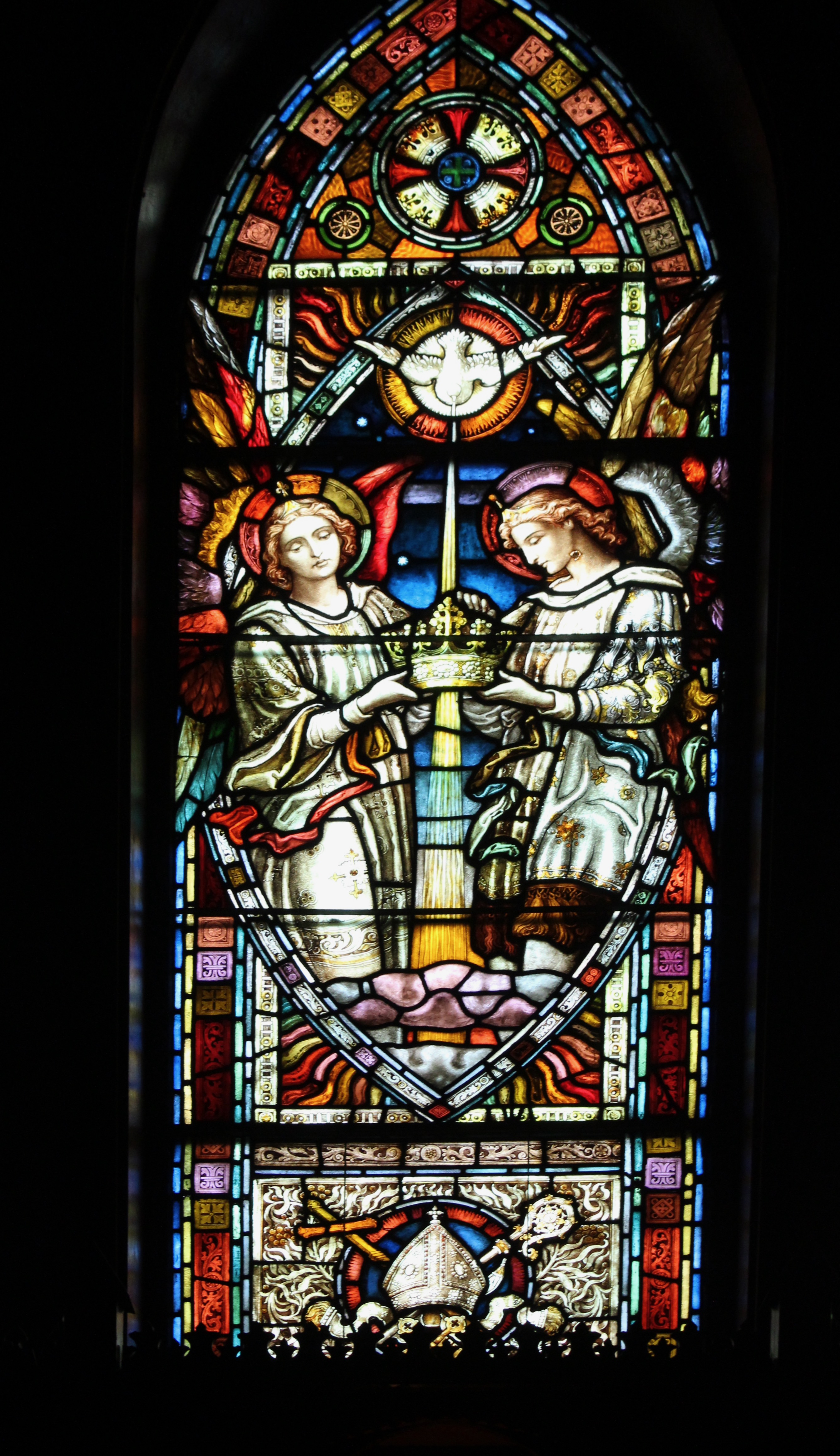
This past Sunday was much like most others. We could see good news right before our very eyes. We have a beautiful stained glass tryptich above the reredos that has been in great need of repair for a very long time. It got fixed last week, and not only that, it got cleaned, so the colors are even more beautiful, the light more truly itself, as it comes pouring in. Then, we ended the service with our quarterly town hall before the dismissal. Perhaps not liturgically correct, but a good way to keep communications open and transparent in our parish—indispensable in the midst of so much change. We have these town halls because, surely, having come together in prayer and eucharist, our hearts are more open to give and receive the vital information our parish needs in order to keep moving further into service after worship ends each week.
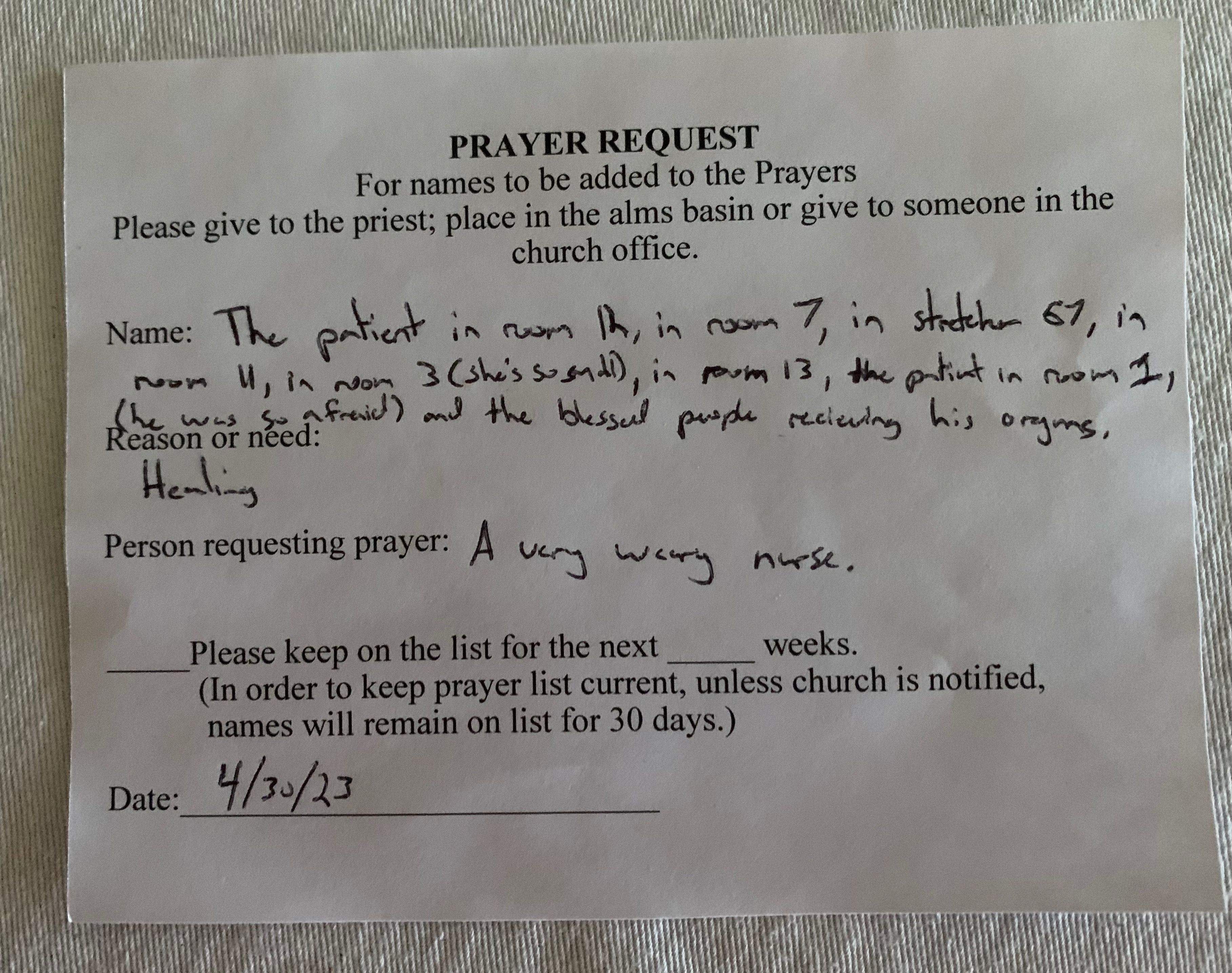
But this Sunday there was a small difference, easy to miss. A young man in hospital scrubs and a jacket that identified him as an Emergency Room nurse, came in a bit before the service began. I was only able to connect with him briefly and was pleased to see others greet him warmly as well. I wondered if we’d see him again.Yesterday, a staff member was in our narthex and found the slip of paper in the following photo.
I hope with all my being that this new possibility of many colors growing amongst us will blossom magnificently—we all so want to trust this is the kind of future God dreams of for us. As we go through old files, stuff pushed into cabinets, things boxed up years ago, it is clear: all the stories, the layers of laughter, tears, and community, that have been built on this land are kept alive in memory by a thousand and one mementos and reminders. Most, if not all of them, are infinitely dear to those who have been here a long time because they retell the story. All that is true. And. Perhaps on Sunday what we were meant to learn was that in one sense, what truly matters is that our church, with all its blessings and challenges, once again opened its doors. A person who needed some beauty, some grace, and a place to sit quietly after a horrendous night in the ER, got to regather himself, had a place to go.
What’s here. Right now. This is what we have and have to offer…
I don’t remember a season when I have been as busy and stretched thin as I have since early December. With the benefit of hindsight, I realize COVID knocked more out of me than I was willing to admit. Whether I paid attention or not, whether I slowed down or not, after COVID, it took so much more energy to do whatever was in front of me. I have hardly written. There are people I love I’ve lost touch with. These days and months haven’t been bad but they have been really hard with more deaths and funerals than I want to remember. There have been more times than I care to count, when I took care of everything directly in front of me and then sat by the fireplace and stared into space, too tired to do anything else.
With Holy Week and the Sunday of the Resurrection now behind me, I am slowly finding my way back into a life that feels more familiar and at least a little more settled. I return with some new insights. Along with finishing raising the chickens we were entrusted with in October, I have also raised Bean and Berry, a pair of African Geese who came to live with us when they were 3 days old and are learning to guard the hen yard from air predators. In case you didn’t know it, geese poop. A LOT! Whilst adding them to the menagerie meant more work, tending to the farm animals who share our life has been the most grounding, joyful daily responsibility I have accepted in a long time.
I’ve been wondering why that was so. The best I can understand why it has been so good is because this is all so incarnational. I must ensure there’s good air circulation in the coop to prevent ammonia vapors from building up and affecting the health of the chicken ladies. I’m using the deep litter method to help with this which means weekly, I pick up a shovel and turn all the pine shavings over and add some more. Then, I scatter something called diatomaceous clay on the litter, as well as herbs and a dry flower mix that helps keep mites and lice at bay. There is utter satisfaction when I finish that work each Saturday and stand in the coop that is so sweet smelling, so fragrant. Daily feeding, daily starting a new batch of feed that needs to ferment for three days, and now, daily picking 5 or 6 extraordinarily beautiful eggs. The list goes on. And it is heaven!
Reinita, Duchess, La Pecas, and Canelita
Perlita, our escape artist par excellence and our endless explorer
Abundance–I feel like I need to thank my girls every time I gather their eggs
The geese have required some different chores. O.M.G., the nasty messes I have cleaned up. We take daily walks in the clover patch out in one of our fields so they can eat to their hearts’ content. One is grown up enough to honk and both follow me around like puppies when they are out of the hen yard. Because I spend a fair amount of time out in the field, Sunny and Gilbert, our cats, also come out and now have occasional standoffs with Bean and Berry. I still work out on the elliptical from heck, but the physical labor that comes with tending to farm animals is different, especially because I experience the immediate satisfaction that comes when I think, “everyone’s fed. Everyone’s safely put up for the night. The coop is hospitable and healthy for another week.” Without this part of my life, I might have buckled under the weight of these past months.
Bean and Berry Who Still Think I Am Mother Goose
The new program we are preparing to launch at my church, the “Many Colors Arts Collective” is close to beginning to come to fruition. We will pilot the model of arts-based day programming for people who are cognitive or neuro-sensory divergent this summer and then plan to formally launch in September. That fragile and remarkably resilient and strong parish I get to serve is also on the move.
After a couple of serious health scares, Sherod is doing as well as he ever does. I don’t take a single day with him for granted. I have a night meeting tonight so I will go into work a little later today. A while ago, we took our dogs and our coffee to hang with the geese and watch our chicken girls do their morning thing. Standing next to him, feeling his warmth and sharing amusement at all the antics around us, I was very aware that my deep fear of the inevitability of loss was not nearly as strong as the sense of pure contentment.
I’m hoping I’ll get to come back to more regular writing but I am also more accepting of the fact that my life ebbs and flows in very unexpected ways now. Here are some pictures of that life until I am back here again.
The pecking order is a real thing in chicken flocks. So is being ‘hen pecked.’ I have watched one or the other of the Big Mamas extend her neck out as one of the young ‘uns came by and just peck the heck out of her or him, pulling out a mouthful of feathers for good measure. That is not unusual as new and old chickens come together to be a new flock. And then there can be bullying.
I have a bully in the flock right now. She is relentless. She actually looks around to see who is standing alone and makes a beeline to harass her even when the other chicken is nowhere near her and Big Mama has already gotten plenty of treats from me (she does it to Buckie too—and he’s scared to death of her); All the members of the new part of the flock are simply terrified. I have been reading a lot about chicken behavior and bullying can get to be a real problem, especially if the bully ends up drawing blood on any of the chickens lower on the pecking order. That causes everyone else to pile on and really attack the wounded bird and can even kill her or him.
As far as I can tell, there is only one intervention that works. You isolate that big bad girl. María used to call that going into ‘Pime out.’ With a chicken, you do it for a whole day. This morning, after feeding them all, I rounded her up and got her into the tack room the coop is attached to. We now call it the foyer of the Taj Mahal. She had food and water. Sherod promised to check on her a few times before I got home. While she was out of the picture, there would be some reshuffling of roles and rank among the critters who constitute the flock and she would only be allowed to go back into the coop itself later this evening, when everyone else had chosen their place to roost. My heart was breaking for her as I left her this morning. Chickens are flock birds and they rely on each other to be their true selves. I felt miserable all over again when I went to see her and the rest of the flock mid-afternoon. She stood very still, looking awfully forlorn. The rest of the flock seemed to be having the life of Riley, running in and out of the coop, hopping on the roost bars, rolling around in the dust bath someone created by scratching away all the litter in one spot of the coop floor. “Spa day, girls, come on, don’t worry! She’s not here!!!!”
When it was time to end “Pime Out” and allow the hen back in the coop, she went in and immediately hopped on the roost bar she and the rest of the Big Mamas sleep on. With nary a peep, she settled herself down and it was the very image of the peaceable kingdom in there. The other times I’ve seen her enter the coop after dark, when others are already settling in for the night, she puffs herself up and stomps around, spoiling for a fight. God help the foolish young one who hops off the roost bar!
I am hoping and praying today did the trick. That thing of consequences, setting boundaries, having to name unacceptable behavior. It’s hard.
As uneasy as I have felt about drawing this line in the dirt, I have had some other matters to attend to. On Sunday, we doubled the size of the hen yard by adding another 100 feet of predator-proof electric fencing. Everyone likes that.
Prattville Farm Center tells me they are taking delivery of several different types of goslings on Feb 24th. I am making the first preparations to bring home two and, since PFC also will have little chicks, I’ll also bring home another 4 of them. A smaller new addition of chickens and goslings would be riskier because when it comes adding any members to the flock, numbers matter, along with size. The six will spend time together in the brooder box until they are ready to meet their chicken sisters and brother outside.
Here’s what I’ve learned about having geese in the family: right from the start, they need to have a watering source deep enough that they can submerge their beaks all the way past their nostrils. After they’ve taken a bite of food, they need to suck up some water through their nostrils so the food goes down their throat. Additionally, they need to blow their noses regularly; this too is done in the water. They grow fast, they do not roost, they are extremely weather-hardy so they need far less care. They imprint on their human caretaker and will follow him/her/them around as much as possible. They poop a whole lot 🙄. They start scanning overhead when they are very young and will make a great big ole racket if they see anything that looks like an air predator nearby. Chickens hear the racket and run for their lives into the coop, closed enough and with a small enough entrance down low, that an eagle or owl will more than likely not try to get in.
My morning routine is less sedate and slow now. I still try to have some time for quiet and to ease into the day, but there are several morning tasks I need to do before getting ready for work. Now, while the morning temps start in the 30’s and 40’s, I come back inside with bright red, aching, cold hands. It’s worth it though. When I leave to work, I do so with the reassurance that I made my bed and I took the best care I could of creatures so dependent on me.
Coming out to take care of the cats and chickens in the morning last week, I saw my first daffodils blooming. My roses are really coming out of dormancy now. More birds are stirring. It feels like we are edging towards spring. When the day that follows is as filled with sunshine as today was, there’s space for something more than despair. It’s not that everything’s alright in the world. God knows, that earthquake in Turkey and Syria. The Russian army amassing in Eastern Ukraine. All the mean-spirited, hateful rhetoric that flies so quick and easy all around us. Such excruciating suffering in so many places. It’s not denying any of that. But surely, daily turning over as much poop as I do, because we are using the deep litter method in the coop, makes me more ready for whatever the day holds.
I walk back towards the house, hands in my pocket trying to warm them, holding tight to the knowledge I share space, life, and light with creation. I accept that it is precisely because I’m a speck of nothing in the magnificent vastness of everything my life is connected to, that I can carry some hope into another day. And try hard to just maybe make a tiny bit of a difference.
December was rough. At the very end of November, my “mother-in-love” died after many, many years slipping deeper into dementia. For her it was release. For those of us who loved her, the loss is still hard, all these weeks later. Then came an eye-blink of a visit with my sweet girl who was more withdrawn and disconnected from me than I’ve ever experienced. A few days later, it was a round with Covid; Sherod and I both got it and the timing was awful with Christmas around the corner. I tested positive for just short of two weeks, on the 20th, the day I finally tested negative, I found out my brother’s first wife, one of the most beautiful, luminous people I’ve been privileged to know, died of suicide. Five days later, Sherod’s squadron commander in Vietnam, a guy bigger than life, died of cancer and Sherod spent several days travelling to North Carolina to officiate at his funeral. And Christmas woven all through that, along with the exhaustion everyone says comes after Covid. Rough
The coop and yard finally ready with the protective electric fencing.
The Big Mamas settled in for the night
The thing is, there was a thin golden thread weaving through those days, a daily responsibility for continuing to raise 8 gorgeous chickens who arrived in the tiniest of boxes and grew, and grew some more, and then some more. We’ve never before had so many biddies to raise at once so the planning we’d done was woefully inadequate. Nonetheless, there were answers to all the challenges and each time another piece clicked into place, the sheer satisfaction of having it work, even if just for a few days.
Buckie hanging out with the babes
There have been surprises along the way too. The funniest came on the most bitterly cold day of the Christmas freeze. With windchill that morning (I think the 23rd), it was 12 degrees in Lowndesboro. I bundled up with layers and layers to go out and tend to the flock. Sherod and I had rigged up this propane heater, that looks like a jet engine and roars like one, that blew heated air into the coop. My job was to turn it off in the morning long enough to make sure everyone in the coop was still alive, to refill feeders and let the girls out, or at least open their little door so they could go out if they dared.
That morning, everyone was alive and well and as I entered the coop, I heard it. A very early effort by a little girl chicken who wasn’t, who was instead a rooster, trying to crow. Oh my stars, he melted my heart with that sorry little, croaky effort. Last time this happened, we gave away the rooster that arrived in our flock. This time, I’ve been researching how to manage the most aggressive rooster behaviors and I’m working with Buckie to teach him some manners and make clear he is not the boss of me. We’ll see if/how that works out.
Something else really funny has happened. For the past couple of years, the older hens, or Big Mamas, as I call them, have hardly laid eggs. Additionally, egg laying drops precipitously when the cold sets in so you don’t expect any eggs at this time of the year. Well…get them in the new Lowndesboro chicken Taj Mahal. Have them see all these young whippersnappers getting ready to be as fecund and abundant in eggs as chickens ever are, and you get your rear in gear. Next thing we knew, we are finding one or two, on some days, three, eggs nestled in the straw in the coop. Then they discovered the nesting box condo and some are laying in there instead, though one prefers the quiet corner at the back of the coop.
Until the week when congress was electing a new Speaker of the House, the Big Mamas and the babies were segregated from each other. On that Thursday, I began the slow, careful work of bringing them together. I kept thinking of the passage in John where Jesus describes himself as the Good Shepherd and says he has another flock that he will bring and they will “listen to my voice. So there will be one flock, one shepherd.” (John 10:16). Well…chickens are aggressively territorial, they don’t think they need a shepherd and I sure as heck know I am not one. All I could do was watch, intervene when it really got bad, and accept this wasn’t pretty.
The little ones staying as far away from the Big Mamas as Possible
The beginnings of détente…
For two days, I spent most of my time out with them in the chicken yard and in the evening would come inside for dinner and to watch the nightly news. What scared me the most was this: the folks trying to elect a Speaker, and the chickens I was trying to coax into peaceful cohabitation, exhibited strikingly similar behavior: the posturing, the pecking, the puffing up, OMG, it was so daggum funny and terrifying all at once. I think our behaviors are similar and we are all, all of us, creatures, of one single flock and there is our poor Good Shepherd, trying to herd us in the direction of the Kingdom of God…
The Pantry
With my morning coffee, I’ve been watching YouTube videos and jumping down rabbit holes of learning about chicken care. I now make my own chicken food by mixing split peas, lentils, flax seed, black oil sunflower seeds, whole oats, whole wheat berries and cracked corn. I’m learning how to ferment the mix to make it go further and to include probiotics good for my girls’ and boy’s gut in their diet. I’m also getting my weight training in since this involves slinging around 40 and 50 lbs. bags of feed.🤪
With all the sorrow of the past month. With the stress of starting a new church year and a new program. With all the craziness of what someone described as a new ‘normal on steroids,’ I give the most profound of thanks for this small flock of creatures I now share life with. Friends and parishioners have given me gifts that make me bust out laughing This is just one… I can hold most of the young ones in my arms, rub their backs, simply hang out with them. They all have names now: Perlita (little pearl), la Pecas (Freckles, Canelita (Cinnamon), Monita (little Blonde), Reina (Queen), Dulcinea, la Peludita (little Fuzzy) and, of course, Buckie. The flock has been becoming one in fits and starts with a fair number of plucked feathers, little ones running for their lives, and Big Mamas being the mean girls.
Late yesterday afternoon, when it was already dark and raining, I got home after we hosted our first respite event for 20 children on the autism spectrum. This is the beginning of the launch of the community arts center program at Holy Comforter. I was exhausted and wanted nothing more than to crawl into my comfy chair and shut down. Instead, I put on my mud clogs and rain gear to hike out and make sure all the girls were safely in the coop. The two “parts” of the flock have split up each night, one sleeping on one roost and the other on the other. To my utter awe and wonder I looked in, and there they all were, lined up on a single roost, huddled together, fast asleep.
The One who said “I am the Good Shepherd” in the Gospel of John would later in the gospel ask his friends to abide in God’s love and to abide in love for one another, “that his joy might be complete.” The poignancy of that moment has always gotten to me. Again, I am so clear that at best, I am an ‘along-sider’ for these chicken girls and boy, but through the continued grief, the stress, the tiredness of a busy day after a busy week, I knew something more about what it is like to look at this little flock and know my joy to be complete…
Earlier in the week, the Mallowman and I still felt like c@#p. We had tested positive for Covid; our symptoms were relatively mild, but the key here is relative—we had had the full complement of vaccines and boosters and still pretty darned miserable. Additionally, as soon as we tested positive, we followed up with our doctors and were put on the antiviral that helps mitigate the effects and hopefully, avoid the most serious complications of this dratted bug. Covid is not to be messed with. I find myself looking for ways to ‘raise the red flag,’ with those around me; in fact, am trying to do so but am also pretty sure it’s a fool’s errand. Our communal capacity to look hard realities in the face for any length of time leaves much to be desired; “we are so over this pandemic.” It is my sense that we simply do not have the civic will to make even small sacrifices to be “care-ful” of those who are most vulnerable around us. I fear it will be a hard winter in that regard.
With apologies, I now step down from my soapbox.
Neither of us was at our best and the world hadn’t stopped for us. Right before we got sick, we rigged up a way to move our new baby girls out of a space grown too small for them in the garage and into the new chicken coop. They were safe from the big mamas who share the space with them, they were warm, and they were growing like weeds (they are now almost 8 weeks old; all their feathers are out).
It was past time for the little ones to start getting out into the open spaces where they will live life. Lying in bed, after several movie marathons, I’d been ‘hinking,’ like my girl Maria likes to say, and had a plan to get the babies out in the chicken yard protected from the big hens. We could expect those big mamas to be really mean to them if we threw them all in together. It is one of the comic curses of our marriage that Sherod and I have a hard time communicating around a project like this. I tried to explain and draw a picture in the air of what I was thinking. Sherod snort-laughed and began to wave his arms in exaggerated imitation of me. Of course, I couldn’t keep a straight face so I threw up my arms and walked away. “Fine,” I thought, “I will take care of it myself.” With all that time not doing a whole lot, I kept thinking and thinking, convinced I could find a solution.
And then I did. I remembered I had a puppy playpen I’d gotten for this transitional stage but had turned out to be too small. The first time the pen package was delivered by Amazon, it came without the dowels necessary to assemble it; all I got was the panels. I ordered a new one and had not yet returned the one that was incomplete. Combined, the panels would give me the pass-through I needed. I found some pieces that would work just fine as dowels and had one more ‘chicken run, like the one inside the coop, delivered by Amazon. This morning, I woke up feeling better, though I had a headache I chose to ignore. All the pieces were here so I assembled my chicken yard solution all by my little lonesome self and lo and behold, it is working like a dream. There was sweet pleasure bringing Sherod out to look. It is neither fancy nor real sturdy, but it will do.
Since it’s wintertime and the weather is nippy, I’ve set it up so the little ones can run into the coop and warm up under the heat lamp and heaters whenever they need to. The babies are ecstatic, zooming around, giving themselves dust baths, discovering the big wide world they have been born into.
Me? I probably should have paid a little more attention to the headache and how tired I felt when I woke up. Last week, when I tested positive, I talked to my doctor about when I could return to work. Especially because there are folks in my parish getting on in years, and the RSV/Flu stuff is hitting so hard, she said, “give it a couple of days after you test negative.” I’ve been assuming that by today I’d be negative and free to resume life on Sunday. Not happening. The headache and tiredness come from the fact I am still testing positive. Take it easy. Hurry up and wait some more. Be patient. I am fortunate that, while it is taking way too long to get over Covid, my symptoms could be so much worse. That doesn’t mean I have to like it. But at least I can sit out in the sun and watch my babies play…
It gets grey, rainy, breezy, windy. Even when it isn’t that cold, the humidity is relentless and the days raw; my knuckles ache. The unctuous red mud. That mud that is everywhere when you live in the country. That Alabama red clay is its worst self when the rains come.
All that is true and so is this: The besotting beauty, when the rain has passed and the ground fog, quietly, ever so quietly, slips in and wraps itself around my heart. I love this place.
Artwork of An Artist In Residence at Spindleworks in Maine
When I came to serve at Church of the Holy Comforter; like so many other parishes in the Episcopal Church, the world had changed out from under what had once been a large, vibrant faith community in Montgomery. Something had to be done and so much of the effort in the 90s and the first decade of this century was to try to figure out how to do what we’d always done, just better enough to bring new people in. At least for this congregation, that simply did not work well enough.
About six months after I arrived here, we began a process of discernment. I often return to the root of this word: it is derived from the Latin word for sieve or sifting. That first round of discernment had to do with figuring out what we had always done in the past, that was entrenched and taken for granted, and now mainly wore people out. As our numbers got smaller, fewer and fewer people had to do more and they were tired.
Then, towards the end of 2019, we were selected to participate in an ecumenical program that was intended to help congregations like ours find the way to leverage our facilities in support of a social enterprise of some sort. This approach saw the effort as a way to create a new revenue stream for the participating churches while working to meet a genuine social need in the community. Then, the pandemic hit and everything began to get bogged down. It just didn’t seem like exercises and activities we engaged in gave us any real clarity about the way forward. Finally in January of this year, we came to the conclusion that it was not a sustainable process for our congregation. With real regret, we bowed out.
Just because that process hadn’t worked didn’t mean we could quit trying, just wait for God to send a nicely wrapped miracle our way. First with a very small group, then with the vestry (leadership team of our church), we started a very tough conversation about the future. In a sense we had to be willing to face into the very worst-case scenario, the possibility that our church would not make it. Those early conversations were as raw and heartbreaking as any I have been a part of. And at the same time, I was so proud of the resoluteness and courage with which leadership team was so honest as it tried to discern a way forward.
In an unexpected way, the despair and sorrow that were articulated opened space for one of the leaders of our church to say that, regardless of what happened, he hoped we would not use the resources we have left to simply postpone the inevitable. Instead, he hoped we would find the way to use all the blessings we have received over time, as well as a pretty magnificent facility, differently. Would it be possible to find a way, whether we live or whether we die, so this little corner of Montgomery could still be a place of blessing to the community? All through the earlier part of the conversation, it had felt like we were sitting at the foot of the cross and then, by the grave on Holy Saturday. Now, that hope started to roll away the stone from the grave.
The conversation became much more generative as we started brainstorming what we might do with the things that we have to work with. I think we ended up with a list of six or seven different ministry possibilities. In the midst of all that, I happened to watch an episode of a fun and silly travelogue series on Netflix called “Somebody Feed Phil.” In that particular episode, Phil was in Maine, highlighting the food scene in Portland and beyond. About midway through the episode, he made a stop in a town called Brunswick about an hour away from Portland. He explained he was going to visit with a relative of his and came to a very New England looking kind of clapboard house. A woman, clearly born with Down syndrome, came out to hug on his neck with great glee and delight. She led him in to a place that I continue to find simply miraculous.
Spindleworks is a community arts center that brings together people who are cognitively and neurologically divergent to the extent that they are unable to function independently in a “mainstream” environment. During the work week, people who fall under this general category come to Spindleworks for the day. They are there as artists in residence and are joined by a variety of local artists who serve as artist mentors. The house is quite large and has an area for the textile arts, a pottery studio, a shop with the kinds of tools that allow for sculpting and woodwork, a music studio with lots of rhythm instruments so local musicians can jam with the artists in residence. I was able to visit Spindleworks on the day my vacation ended. What follows are a few pictures of that visit.
After the leadership team and I discussed this possibility extensively, and after the other ideas we had identified couldn’t quite come together, we agreed we would try to create a similar community arts center in Montgomery. A remarkable number of pieces are coming together; I tell people it feels like a warm knife cutting through soft butter. Of necessity, our program will not be identical to Spindleworks. For this to have a chance to thrive, partnerships are going to be essential. Our first partners are a small nonprofit that serves families of children with autism. Because there are so few services for people of all ages challenged by neurosensory and cognitive limitations, we are simply exploring the range of people we will be able to serve.
One of our local universities, Auburn University – Montgomery is very interested in helping us develop this into a training center for students who anticipate working with special needs individuals like the ones we will serve. I will meet with a couple of key leaders from the Montgomery School System next week because they too see an urgent need. I have not lost sight of the needs of adults. Last week, I took a course offered by the state for organizations that want to offer services to the “developmentally disabled” adults in our community. If we get certified by the state, we will be able to become providers who can be reimbursed by Medicaid for services to this part of the population. There also seem to be quite a few grant opportunities that we will pursue.
The only way forward is one small step at a time. In January, we will pilot a monthly respite program for elementary school children with autism and/or significant cognitive challenges. Will it all come together to become our own community arts center? Is it possible this is what resurrection looks like in our time and place? Time will tell. What I know for certain comes straight from the Bible: “Where there is no vision, the people perish.” May it be that the Spirit of Truth and Light will give this vision of ours joyful life…
So yeah–we thought it would take two weeks to turn half of the tack room we no longer need into new digs for our chickens. like most construction projects these days, we were a little optimistic. We are at the end of the 2nd month of work. The chicken coop, with lots and lots of repurposed materials, is getting close to being done. Outside: stained and sealed. One part of the apron of panel fencing that goes down all around it to coop to keep predators tunneling in has already been put down but we have more to do.
Inside, the painting is largely done and the nest box condo is up–although it’s coming down about 7-8 inches so the sweet hens don’t get vertigo getting in to lay their eggs. Also, I even have some paint on my eyelashes…
We designed the coop so the Mallowman is able to pull the tractor right up to the entrance so I can shovel the pine shavings into the tractor’s bucket. We will do this quite regularly to keep the coop sweet smelling and clean. Cart it off to a corner out of the way, let that stuff sit for a while so it makes awesome compost.
The bottom half of one side of the front swings open and the other full door opens too–that’s where the tractor will stop. My eternally, awesomely creative spouseman has rigged up a little door we’ll be able to bring up to let the girls out each day and close at nightfall. One day, I hope to talk him into letting me install an automatic door that you can program to open and close at daybreak and sunset. Until then, that line, “Up with the chickens” will describe my early mornings, rain or shine.
We think we’ve provided enough ventilation and can also do more if the need arises. There will be panels to cover all the windows when the weather gets really cold.
So what’s left? We are making roosts for the ladies (and I read they should all be equally high because otherwise the pecking order fusses that get stirred up are mighty). I will rake out a lot of the dirt on the bottom of the coop and we are going to cover it with pea gravel (Bubba’s Materials in Prattville sells them for a reasonable price); this helps with drainage. A five or so inch of pine shavings will cover the gravel. We keep finding spaces a snake could slither through but those are easily closed with insulation foam. And then, it will be time to set up the electric fence to keep predators away during the day. Our older ladies will go into their new space in about 2 weeks and our newest babies will follow about 5-6 weeks later.
I had ordered twelve little chicks but some did not hatch so I only got eight. I’ll wait until early spring to get another four. The bit I am most thrilled about is that in March, I am also preparing to take delivery of two goslings, I hope gray Pomeranians; you can see what they look like here. When they grow up, they will be a huge help with air predators. Plus they are just too cool for school.
A month ago today, my time of hiking and exploring in Maine had ended. I drove away from the tiny house I was staying in, go into Portland so I could catch my flight the next morning. All I had left was a stop in Brunswick for a quick visit at an arts center I’d heard about. There’ll be more to tell about that visit soon. But today, in my home office, with my girl Tuxie sprawled out next to me, and the chirps of little peeps filtering in from the Florida room right next to my office, the whole month of September feels like it happened a lifetime ago. That realization is sobering.
I think I wrote elsewhere that as my flight approached for landing in Portland, I sensed an unexpected shift inside of me, a loosening of some of the things that too easily hold me captive, including anxiety and perfectionism. It was thrilling in the days that followed to simply show up, to practice ‘disponibilité,’ making myself available to what each day might bring. I look back on the day after I got home, when the rug slipped out from under my foot and wonder: was that a metaphorical fall back to earth? I had come home so determined to return to the ordinariness of my life with the kind of freedom I’d been graced to receive in Maine .
Clergy types like I often comment that October is insane in the life of a congregation. There are all kinds of reasons for the insanity and this time around was no different. Day by day, the sense of freedom got eroded a little bit, and then a little bit more, and then again, another little bit more. I can retrace my steps over the past month and see the places I kept losing bits and pieces of that ‘lightness of being’ I was so thankful for. At the same time, I can also see the moments when I was able to stop, to breathe, when I remembered and insisted for myself that even in this most crazy of months, the freedom is still possible, is still there for the taking.
About 10 days ago we had couple of frosty nights. The kudzo is in retreat; that always pleases me. But what was really the very best, was the color that suddenly burst into flame. In the morning, when the light hits just right, you come around a curve on Old Selma Road, and I at least, just have to pull to the side. I came across a gorgeous line in a book review in the NYT this morning that says it perfectly:
“ Whoever stood there and looked at this would never want to utter even a single word; such a person would simply look, and be silent.”1
There is a large parcel of pastureland right across the road from our home. About two weeks ago the hay that had grown almost waist high was harvested; bales and bales lay scattered around the field until yesterday when some began to get hauled away. Again, it is the light, the golden light of a fall afternoon, that makes my heart calm itself into the kind of slow, steady rhythm that says, ‘you are alive. You are alive. You are alive.’
And then, of course, the cuteness overload that comes at 7 o’clock in the morning, when our lovely post office lady calls and says, “Miss Rosa, your chickens are here,” and you throw on a jacket, hop in the car and turn up the heat full blast. The box you receive is so tiny and so loud. The little ones, when you put them in their temporary brooder, are so stunned and bewildered. There’s the awe that they haven’t been alive for more than about 52 hours and yet survived a journey of hundreds of miles and are now eager to take up life in this strange new world. The forgotten delight, watching them discover water, take a small sip and then, bend back their heads, put their tiny beaks up in the air, so the water can gurgle down their throats.
Yup, October gets cra-cra with stewardship drives, Advent planning, budget planning, people getting sick, others getting their hearts shattered, with budgets and sermons. All that is true. So is the dazzled curiosity of my funny girl dog figuring out about those itty, bitty, tiny, little biddies.
Retracing my steps to September, finding even just a tiny little piece, one as small as Julian’s hazelnut, holding it in my hand as carefully as I hold the fluffy little peeps, I am reminded, freedom is still there for the choosing.
I woke up a couple of times last night; the feeling I had both times was that I was crushed under a load of bricks. The weeks since I returned from Maine have been insanely busy and every now and then, woven through the days, has been the news that there’s some real concern about another Covid-19 wave washing over the holidays. It would certainly fit with the way this has gone since 2020.
So yesterday, this person who hates shots more than just about anything, got herself to Publix and I bit the bullet—I got the new booster supposed to be more effective against omicron and since I was already getting one shot, I decided, what the heck, I’ll go ahead and get the flu shot too. The vaccines hit me hard. This morning, I feel like I managed to crawl out from under the pile of bricks and my whole body is bruised and battered. Plus, it feels like it took all night to get out from under there so I am exhausted. I may still one or the other—both viruses are pretty vicious and insidious. The hope is, the vaccines should help me get less sick if I do get infected. Even more, I am thankful for a step I could take to keep others I love in my family and my church a little safer. This PSA is simple: I hope you will get a booster. And maybe the flu shot isn’t a bad idea either…





 New Road Rising