
“This is going to change you”. Someone said that to me a couple of days ago. It was a kind and thoughtful response to my stumbling efforts to describe the place grief has in my life, especially now, since Maria has moved out of our home and for now has no contact with us. This person made the comment after describing a conversation he’d had with a man who was kidnapped and held captive in South America for several years and still managed to come out on the other side remarkably strong and well adjusted. At the beginning of his captivity, the man realized that the experience would change him fundamentally. He made no effort to cling to who he had been and instead focused on who he was and was going to become and one day, he was set free.
I’ve been changing for the past year. It started the evening I stood in front of my closet figuring out what to take to Panamá and realized I needed to pack clothes for my mother’s funeral. There was a different certainty to the decisions I made that night. There was also a new center of stillness. When I got to my parents’ house on the evening of May 23rd, I had to catch my breath, really see that my mom was dying. By the following morning, I had stepped into a new role when I insisted to my dad that we would meet with the voluntary hospice team that works in Boquete. I look back on all that with some amazement. In an eye-blink, I stopped being the daughter and child and became an adult who needed to steer a household not her own through strange times.
I did not stop to question that I had to provide some steadiness, whatever steadiness I could, not just to my dad, but to Pastora, the housekeeper, and Paulino, the gardener, and my aunt, and even some of my mom’s friends who had always been my elders before, and now were wobbly and vulnerable in a way I wasn’t. My older brother arrived a few days later from Holland and brought his own wisdom and strength but I functioned as the matriarch of our family for the rest of our time together. About three days after I got to Boquete, my mom sat on the side of her bed, with all the vulnerability and trust of a child and asked me, “Rosita, do you think I’m going to get better?” I had a split second to decide how to answer, not wanting to be deceitful but sensing that the blunt truth would be too much for her. “I don’t know, Mom. I hope so but the cancer’s in your marrow now, which makes everything harder. I am here with you today and I am so thankful for this time with you.” I don’t know if it was the right answer but it got us through to the next moment. There were any number of encounters like that during those weeks, where what I said and how I said it mattered to a lot of people.
In the weeks after Mom died, when several other people I cared for died too, and I had to officiate or participate in a whole series of funerals, I learned that part of being grown up is compartmentalizing and putting your own “stuff” on the back burner to be true to your work and vocation. I would have thought such a succession of funerals so soon after her death would shatter me. They didn’t. Ironically, I had something else going on, far more serious, far more capable of robbing me of my life. I had become diabetic and had been stubbornly refusing to recognize the small signs and warnings. Finally, a few weeks after Mom’s death, I managed to overcome my denial enough to go to my doctor. When she showed me the results of my blood work, I could not play the game of denial any longer.
I got my diagnosis a few days before I was supposed to go on a much-anticipated retreat with the Jesuits in Maryland. On the morning I was supposed to leave, I had the mother of all rows with my spouse and was confronted with the fact that you don’t pour yourself out to take care of one part of your life, without other parts paying some of the price. I’d walked with someone else’s household through to death and left my own household to fend for itself. I couldn’t just up and leave again. To add to the stress, I had thought as soon as I started taking the diabetes medication, all would be well with my blood sugar. I was completely mistaken. My blood sugar levels were still way high and I couldn’t push through the truths right in front of me that I’d have preferred to ignore. I cancelled my trip feeling not regretful but liberated.
Until that day, I had intended to keep the fact that I’d become diabetic to myself—I felt so ashamed that I had let that happen to me. Somehow, on that morning, a whole bunch of pieces came together that helped me see that I am no longer able to put up much of a front, pretend and pose for the sake of an image of myself that just isn’t real. I told the leadership of my church about my diabetes and even began to have careful conversations about my weight and food with people around me in ways I had never dared to before. I can’t say it felt good. To this day I fight the shame of having to work so hard to manage my eating. But pretending takes more energy than I have any longer.
Recently, I watched a TV series called Firefly. In an episodes I really liked, one of the characters says, “When you can’t run any longer you crawl, and when you can’t crawl any longer, you find someone to carry you.” In a very paradoxical way, the strength I find now is the strength to ask for help. It has taken an incredible amount of intention and effort on my part not to isolate myself over this past year but I really haven’t had any other choice.
I have also come to terms with complexity at the heart of my life. A marriage and family are full of complexities and complications. Being a priest while the church is in serious decline is like navigating through a maze in the dead of night with an enormous responsibility not to fail the people who have entrusted me to provide leadership and steadiness when everything is in upheaval. How do I let go and yet stay connected to my daughter who was abusive to my husband and me from the moment we received her into our care, who looks like a monster on paper if you read a list of her diagnoses, and has also been one of the true miracles in my life? The list goes on. There seem to be hundreds of decisions placed in front of me with a relentlessness I was not aware of before. In the end, though, they boil down to a very basic choice posed to me by my Creator: “On this day I have set before you life and death. Choose life that you may live”.
Before this year, a lot of my life was about anticipation. “Ya casi es mañana” (it’s almost tomorrow) was long a favorite catchphrase of mine. That has changed. Surely, I will have new dreams for myself. But not right now. I’ve been talking recently about my sense that choosing life right now means staying in the moment, to host grief. I guess that’s a fancified way of saying that I am grieving; still, I like some of the implications of framing it that way for myself. My mother and my grandmother were consummate hostesses and I now use some of the silverware I inherited from them for everyday purposes to remind me of their graciousness. But there’s another way of being a hostess that I did not learn from them, that I’m learning on my own. I am learning to open the door to something so unwanted and unlovely I would never have received it before.
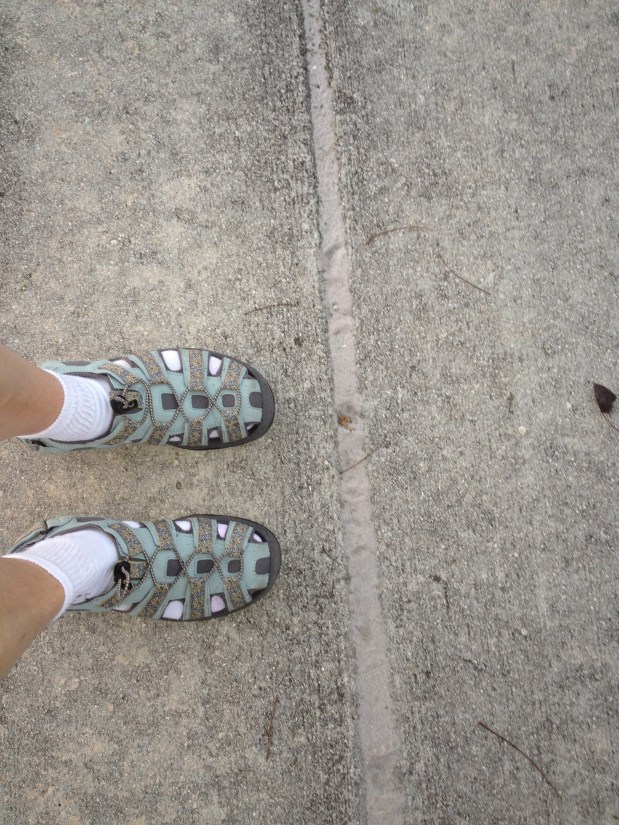
In a strange way, having diabetes allows me to open the door to grief when it shows up, not invited but ever so persistent. I used to have all kinds of ways to numb out, but my favorite was eating. I’ve replaced the eating with a lot of walking and in the quiet of nightfall, like the fog, it arrives on little cat feet. Some nights the grief gets so intense on my walks that I have to lean against a tree or sit down as soon as possible because I simply cannot hold myself up. The thing is, if I will not fight myself, even if I think I’m hurting so much I’m going to die, the pain moves on and I take the next step, and the next, and the one after and eventually, I find my way back home. I fall asleep, morning comes again and there’s a whole new piece of life making claims and asking me more questions. I have changed and I imagine I don’t even know the half of how much more I have ahead. What hasn’t changed is this: I still choose life.