Good Friday

Good Friday

Rain in Boquete, Panamá

Today, just before members of St. Ambrose gathered to do the Stations of the Cross, it began to rain.  The rain was gentle and cool. The weather is already getting oppressively hot here in South Florida and the rain was welcome.  It’s been a tough week and I could imagine myself standing in the rain, letting the grit and grime of these days sluice off me.  And then I thought of that incredible young man who hung on the cross on a day like today, thought of gentle rain washing the tears away, and the blood, washing him clean of the hate and fear and despair that drove those days we remember together this week.

Before my mom died, I read a book called Here If You Need Me, written by a woman chaplain who works with search and rescue teams in Maine.  Her passage into ministry happened after her husband, a state trooper, was killed while their children were still very young.  In the last two years of my mom’s life, perhaps I thought I could inoculate myself against grief by reading as much as I could about death and dying.  Perhaps there’s some element of voyeurism in all of us when it comes to this particular truth about life.  It was also just a very good book and one of the places that moved me deeply was her description of washing her husband’s body down after he died.

About a week after I arrived in Panamá last year, and some ten days before my mom died, her physician asked my brother, dad and me if we had made all the arrangements we needed to make because the blood transfusions that had given my mom new life would start losing any effect soon and the end would come quickly after that.

Lifelong habits kicked into gear.  When I was a little girl, my parents did a lot of entertaining—my dad was Swedish consul in Cali and I remember my parents hosting an unending number of cocktails and dinners.  My favorite was when my mom would serve High Tea.  Last Sunday, I pulled out some of the napkins I remember her using on those occasions.  This was no high tea—it was one more church meeting; nonetheless, it was fun to play house.  But back to last year:  starting that very evening we did what I remember my mom doing endlessly:  making lists and planning.  We’d sit out on the beautiful porch in my parents’ house, in the evening, after mom was asleep.  It became a ritual.  My dad would pour us each a small glass of Bailey’s Irish Cream and we’d talk through what needed to be done.  We were determined to honor my mother in her dying by avoiding mess, or chaos, or anything unpleasant.  It also gave us some sense of control when our world was spinning and wobbling.  Each of us had moments during those evenings when we simply lost it and the other two were able to be the strong ones for that particular night.  We had a way to walk together through the valley of the shadow of death.

One night we began to plan what we would do after my mom died and before her body left the house.  She had a fraught relationship with her sister and we were determined to keep Mom safe from an overbearing older sister who was used to running the show.  Mom also had a dear friend who’d lost another close friend just a few months before and seemed especially in need of tending to my mom.  We agreed that those two women would help me wash my mom’s body down and put the clothes on her that she had told us she wanted wear when she was cremated.  I envisioned the quiet, gentle, dignified ritual, as old as humankind itself,  a circle of tending and being tended to.

When the time actually came, this part of her death was the antithesis of everything we’d hoped and planned for.  I realize now that I was in shock.  The other two women went into such overdrive that there was manic mayhem around my mother’s lifeless body.  The images are pretty awful to consider, even now, 10 months later.  And then, it was over, we were waiting for the hearse and I was fixated on the fact that no one had put shoes on my mom but I couldn’t bring myself to do it either.  How very strange, this business of death.

As the rain came down this morning, I was reminded of that night last May.  I was also reminded that a few days before, my mom had been complaining that she so wished she could wash her hair, that she was so tired of sponge baths instead of the real thing.  She was still able to move from her bed to a wheel chair and then to her “throne” in the living room for most of the day.  Seated strategically where she could see everything going on,  she bossed all of us around, almost to the end.  Since she was still that mobile, Hans and I figured out a way to get her into the shower in one of the bathrooms in the house.  We planned and prepared without telling her and then wheeled her into the bathroom and got her in the shower.  The water was already running, we were in there with her, having even found a way to respect her enormous modesty, mixed now with shame over the ravages cancer had visited upon  her.  What we saw was her face: the peace, the joy, the pure pleasure as she tilted her head and allowed that warm water to wash her clean.  I washed her hair and Hans rinse her off.  Somehow, the whole thing came off seamlessly and after she was dry and dressed in clean clothes, she slept for a long time.  That evening she was her drollest, funniest self for us.

I understand baptism now, at least a little bit.  How it is a death we go through from life to life.  Michelle Frankl, over at Quantum Theology, reminded me this morning that the season of Lent is not so much about the sacrament of confession as the sacrament of Baptism, a yearly reminder of how we are transformed as we make that passage.  The water that rained down in that shower one Wednesday morning when the dew was still out in my mother’s garden, the water that bathed my brother, my mother and me, washed away years and years of fighting, misunderstanding and estrangement—the stuff of families.   Even my mom’s body, by then so brittle and broken, was made new.  It doesn’t matter any more that the night of her death got so crazy on us—everyone around her was simply trying to get through.  The real sacrament had already happened.

I am not quite sure yet, how this all relates to Good Friday.  Except that I’m glad for the rain this morning.  Glad that what I could do for Jesus was imagine the soft rain washing him clean.  I felt glad too, for the loving hands of his mother, and his unexpected friend, Joseph of Arimathea, who were there to receive  and to tend to his mortal remains carefully and reverently.  Finally, glad that in my own way, I share kinship with Mary and with Joseph.  Glad to have been able to receive death as well as life and to know that somehow, they are inseparable.

Being Loved-The Mystery of It and a Request

Being Loved-The Mystery of It and a Request

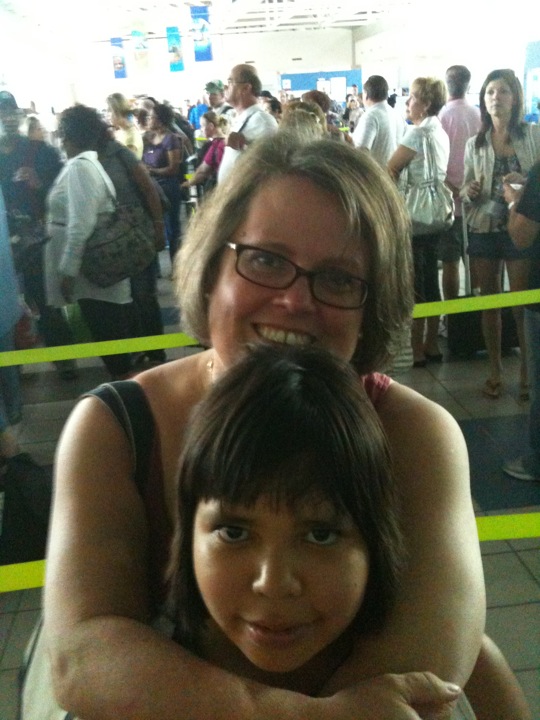
The days are getting longer even as time is getting shorter.  On Saturday, Light of my Life and I went to BARC Housing, where she will live; it was her first visit.  Some of the members of the community have quite profound special needs.  When they are all home, there’s noise and some chaos that can be daunting.  Some of the folks we saw inspired deep tenderness in me, others left me a little shaken and uncomfortable.  We want our humanity well defined, neat and tidy don’t we? At least I do, more than I care to admit.  I was scared as I showed my daughter this place, scared that as soon as she saw the people who will become her extended family she’d want to run the other way. She sees things I don’t and she understands the world with more openness than I could hope for in myself.  At the end of our visit I asked her what she thought and her answer was simple and direct:  “It’s cool, mom.  I wish I could move in today!”  That move is coming so soon now.  It is easier to count down in weeks now than in months.  There’s about 7 weeks left.

With as much as our girl can’t verbalize, with as much as can and still does go wrong with her that makes our family so fragile, she is still the most absolutely amazing daughter. Ever.  On Sunday evening Sherod and I worked with a group of people here at our home until about 7:30.  After that, I went on my regular evening walk and by the time I was almost home, it was dark with lots of stars and the moon out, showing me the way.  I did what I sometimes do if I have my phone with me.  When I was a little more than a block away from home, I called LM and she came hurrying to meet me.  We make a game of it–I crouch down and extend my arms wide, she comes barreling into me like we haven’t seen each other in forever.  Then we walk the rest of the way home, holding hands.  On Sunday evening, we threw ourselves down on the sweet grass in front of the house and looked at the night sky.  It felt like something out of Ray Bradbury’s magical book about about summer, Dandelion Wine.  Sometime soon after we brought LM home, I found myself making up a song for her, playing on her first name, Luz.  Sometimes I call her “Lucerito” (little star) and this little song is about how she’s dressed in light and is my little star.  We looked at stars on Sunday night and together sang “María bonita, vestida de luz”.  When we got up to go inside, my Lucerito spontaneously reached out and hugged me, something she does very, very seldom.  Holding me tight, she said, “Mami, I am going to miss you.”

Every day, LM brings home a “point sheet” that summarizes her behavior for the day and has a space for her teacher to include feedback about things that went well and things that didn’t.  Yesterday, Ms. P, Lucerito’s wonderful teacher, wrote that out of the blue in class, our girl announced “I love my mom very much. She takes good care of me”.  What an incredible gift, stirred with a tiny twist of bitter irony, that as I prepare to loosen my grip, entrust her to the life she has been given, I get to see that love has had a chance, that for all her diagnosis of reactive attachment disorder, and all the failures to bond this diagnosis implies, she is my daughter and I am her mother.

I end this post with a request.  One of the things I love about my Mac is how easily I can take up  a book or multimedia project.  I am starting on something that may be a book or may be some kind of multimedia piece for LM to take with her.  If you have a picture (jpeg, please), a memory, a story or a message about or for her that you would be willing to share with me, I will gather all that together with some of our own bits and pieces.  Please send what you would be willing to have me include in this project to rvlindahl@me.com by April 16th.  That will give me time  to get it all done by her Birthday on May 16th.  Thank you…

The Fire and the Rose

The Fire and the Rose

We shall not cease from exploration
And the end of all our exploring
Will be to arrive where we started
And know the place for the first time.
Through the unknown, unremembered gate
When the last of earth left to discover
Is that which was the beginning;
At the source of the longest river
The voice of the hidden waterfall
And the children in the apple-tree
Not known, because not looked for
But heard, half-heard, in the stillness
Between two waves of the sea.
Quick now, here, now, always—
A condition of complete simplicity
(Costing not less than everything)
And all shall be well and
All manner of thing shall be well
When the tongues of flame are in-folded
Into the crowned knot of fire
And the fire and the rose are one.
T.S. Eliot, Little Gidding 

When Sherod and I lived in Memphis, our house had a wonderful garden.  Sherod grew vegetables and had a flowerbed filled with foxglove and echinacea and daisies and all manner of other blooming perennials.  I grew antique roses.  There were times when I could go out to our garden and pick a couple dozen beautiful roses that would fill our home with the most wonderful fragrance for days.  We left Memphis in 1996 and I still miss my roses.  There’s a place in Texas called “the Antique Rose Emporium” with the most amazing collection of heirloom roses imaginable.  I carefully selected my roses from their catalogue back in my Memphis days and just a couple of months ago, in a bout of nostalgia, I pulled up the Emporium’s online catalogue and ached all over again for my beautiful garden.  The weather here is so humid and hot that all I have ever seen around are somewhat paltry, Home-depot kinds of rosebushes, a caricature really, of what grew with reckless abandon in my backyard.

Last night, I was out walking as sunset approached. The sun was low enough that light was kind to everything it touched.  The temperature still drops at the end of the day and the breezes are so gentle they’re a butterfly kiss on my face. I walked by a house not far from ours and stopped in my tracks.  Literally, my heart began racing.  Roses. Roses coming so close to the ones I knew and loved in Memphis.  Bushes growing tall and strong and full of blossoms.  I don’t know how else to describe this but as a mystical moment of connection: connection with my past but also with my life right here, right now, connection with the world, somehow revealed in that garden, connection with a God of such absurd and unabashed abundance.  Such grace waiting patiently to be discovered, simply waiting to be seen…

Above all

Above all

New River Regional Ministry on A Friday Afternoon
St. Ambrose Episcopal Church

Above all, trust in the slow work of God.

We are quite naturally impatient in everything

     to reach the end without delay.

We should like to skip the intermediate stages.

We are impatient of being on the way

     to something unknown,

         something new.

Yet it is the law of all progress that is made

     by passing through some stages of instability

         and that may take a very long time.

And so I think it is with you.

Your ideas mature gradually. Let them grow.

Let them shape themselves without undue haste.

Do not try to force them on

     as though you could be today what time

         — that is to say, grace —

     and circumstances

        acting on your own good will

     will make you tomorrow.

Only God could say what this new Spirit

     gradually forming in you will be.

Give our Lord the benefit of believing

     that his hand is leading you,

     and accept the anxiety of feeling yourself

         in suspense and incomplete.

Above all, trust in the slow work of God,

     our loving vine-dresser.

Yesterday morning, part of the leadership core of the New River Regional Ministry, the new ministry that we are trying to nurture into being, went to a meeting at the Diocesan offices in Miami.

The ride down I-95 is a journey in time for me.  That’s how I got to work everyday for most of my tenure with the LAC Division of FedEx.  I laugh, remembering that there was a big sign on one of the buildings, an ad for bidets.  It had a smiling little stick figure squatting down.  It said, “a clean tushie is a happy tushie.”  It still amazes me that I used to get on southernmost end of I 95 at the  edge of downtown Miami.  More than once, I thought I could just stay on this very highway and get all the way to Maine, even missed my own exit on purpose a handful of times.  The sign for the exit to Jackson Memorial and the VA hospitals always gives me a little clutch.  When Sherod went through the most intense part of his radiation therapy in the summer of 2001, I had to get off on that exit to see him while he was in the hospital and then had to race home to our daughter who had come home in March.

Yesterday, we were going to the Diocese because we still need assistance to keep this ministry going.  That has never been easy for Sherod or me, two headstrong, opinionated people who get very impatient very quickly.  It is always easier, isn’t it, to see the speck in someone else’s eyes than the beam in our own?  In the past few months, we’ve understood more clearly that we’re trying something that does not lend itself easily to the existing funding and assistance mechanisms of the church and that others have had to make enormous stretches to understand the help we were asking for.  Recently, I was introduced to a TV series called “The Walking Dead”; it came recommended for it’s portrayal of people’s behavior when the world as we know it has ended.  The series is populated by large numbers of walking dead folks who are hideously, horribly hungry and who lack all charm and subtlety.  With no intent to suggest that this is what our congregations are like, I imagine that there are times when members of the committees charged to disburse the very finite amount of funds available to aide fragile ministries must feel they are swarmed by endless need that threatens to be all-consuming.

In the past few years, these kinds of diocesan meetings have been sharp, we’ve hit against  sharp edges of fear, misunderstanding and difference many times.  It’s felt like we came out bruised and somehow diminished.  Today I am aware that if we felt diminished, it wasn’t because of what “they” did.   I don’t like having to ask for help.  Rather than recognize any self-doubt and uncertainty about our work, I had an easier time getting defensive and combative.

That “slow, constant work of God” has started smoothing many of those edges.  Yesterday, I was simply grateful to have a place to go to for help.  Our successes are still small and the way isn’t real clear for NRRM.  But  I felt great joy as I talked about the things that are happening in our midst and listened to Sherod tell other parts of our story as well.  I saw faces around the table that just looked human—interested, tired, willing to listen.  I know at least two have lost a parent in the last 9 months—one in the last month.  For some strange reason, yesterday more than usual I would have given anything to call my mom.  I wondered if they too were tucking away grief to do the work at hand–so much of the time that’s what we’re all doing, just getting through the day.

Since we started NRRM, the Episcopal Church has continued to struggle with accelerating decline.   I ache for the other applicants for Diocesan aid who are struggling to keep their doors open.  It’s been too easy in the past to view other needs in the diocese as competition for that very limited number of dollars available to help.  We are all part of the Body of Christ and we are all diminished when any of us fails.  It struck me that ministry has this way of stripping layer after layer of veneer and defense and self righteousness until we are essentially ourselves, aware that all we can really do is open our hands in need, and sometimes in wavering hope and confidence.

Promising word has come back about the results of the meeting.  We’ll know more on Monday.  Teilhard de Chardin’s prayer both comforts and confronts me as I sort through the past week.  It is extraordinarily difficult for me to trust the slow, hard work of God.  Today what I can say is, “I trust, Lord. Help me with my distrust”.  And whatever it is that we have accomplished that inspired others to continue to engage and assist us, Ad majorem dei gloriam

Reaching for Happiness

Reaching for Happiness

The past couple of weeks have been filled with moments of announcement and glimmers of something new in my life.   I may have a map, or at least some sense of being able to see the lay of the land.  But the way is still different and unfamiliar.

I know some things.  I know that I am leaving another place.  The place I have lived and moved and had my being in for longer than I can remember is a place filled with sadness, loss and grief.  It seemed that I moved from here to there just to keep moving.   Moving kept me busy.  And being busy kept me from realizing just how incredibly sad and filled with despair I was much of the time.  It is probably just as well that I wasn’t aware.  I wouldn’t have had the confidence to face into that void inside of me.  Coming as I do from a family with a lot of history of suicide, I wonder if I could have made it.  I am a woman of faith.  I am a priest, even.  But I think my heart was too troubled to give God much space.  Maybe all God could do was watch and wait and hope on my behalf when I lost my capacity to hope. Oh, as a priest I could still talk about it quite convincingly.  I could even visit places of hope for certain parts of my life for a little while here and a little while there.  But dwelling in hope? Abiding in hope?

Around October of last year, that began to change.  In June, my mom’s death had been a mirror that I would have preferred to ignore but couldn’t any longer.  Then, almost by accident, I finished crossing the river of denial related to my health and weight, and on the distant shore, after about 2 years of swimming in and out of eddies and currents of disbelief, I stopped and looked.  I had to look way down into a sink hole with another mirror, the mirror of aging with a chronic condition of insidious destructiveness.   I had to stop and be real.  Tell the real story even when it was embarrassing.  I realized just how much I was using food to numb myself out, to deny the sadness, the grief and the wrenching losses I had not even stopped to recognize.

It was more than I could do alone so I started seeing a therapist.  She is a gentle, kind woman who won’t let me off the hook for games I have long since mastered.  She can disarm me by simply asking me to sit quietly and breathe, breathe deeply.  J has been helping me sort through my early years as an adult, the decisions I made, the path I opened for myself.  I look back on myself with a lot of compassion these days.  I had no earthly idea what honest human needs look like and even less, what my own inner resources might be.  Instead, I invented and improvised and fell back on patterns I saw played out in my family of origin—patterns I am not particularly proud of but understand much better now.

How can you be in any meaningful relationship when you put yourself on like a dress every day and you never quite fit?  Over time, the dress gets stained and soiled, loses a button, and becomes frayed at the edges. You never stop to think this might not be you, so you spend a lot of time putting more stuff on to cover it up.  But it all looks and feels shabby, stifling and shameful.  It is easy to be a bag lady in your own skin, walking through your days muttering to yourself with an edge of angry desperation:  “You stupid idiot.  You messed up again.”

I kept moving.  I kept pitching my tent and pushing my cart full of bits and pieces that I thought made me me.  But I got lost an awful lot.  I also lost many things. One of the things I lost was my engagement ring—a lovely, simple piece of jewelry that symbolized promises and goodness to come. It was as if promises and goodness got lost with it. I was so extraordinarily lonely and afraid.  And the sadness grew in me. It pushed harder and harder so it was hard to catch the next breath.  Recently J called me on the fact that I was sitting in her office smiling, beaming really, and invited me to breathe.  It wasn’t thirty seconds and I was sobbing as grief just poured out of me.  I swallowed an ocean of sorrow over the course of 25 years and I am letting it go.

My walking, my praying, my time in therapy, the fact that I am eating more healthily, my willingness to start naming the grief and accepting the pain have brought me to a new place.  A thin place between sorrow and the rest of my life.  A place where my endurance allows me to reach destinations I set for myself and to accomplish things that matter.  The losses are no less real for my finally having named them—unlike God, when I name things I don’t really have any more control over them than I did before. But naming things allows me to be true to what is and not what I once hoped might be.  It is a form of sobriety.

It is possible that another major loss lies ahead for me.  But if that happens it will be because I am not trying to cover myself up any more.  If there is more left to let go of than grief, it is pieces that are certainly not me any longer and maybe never were.  I will be able to continue to go towards a new place because I know now that I have many more resources inside myself than I ever allowed myself to believe I had.  I am not scared as I contemplate that possibility.

And as I said, I have moments where I have already crossed over.  Tonight as I unloaded the dishwasher, I delighted in the lovely mug I use for my morning coffee.  It is perfect, absolutely perfect for me.  On Tuesday, I stood outside a hospital in my ministerial black—black skirt, black clergy blouse, official looking name tag and clergy collar.  A man I’d watched get out of a car in front of me—an aging, somewhat feeble-looking person, stopped and with a strong, life-filled voice told me how much he liked my subversive, sexy red heels.  I smiled all the way back to my office.

I talked to dear friends this week, each time I went out for my long walks, no longer needing quite as much solitude on those walks as I have before.  Tonight, I go to bed tired and tomorrow morning, I am going to work on taxes for a while, then I am going to a quilt show and coming back to clean my house so it will be shiny and welcoming when the Mallowman and the girl get back from a week-long road trip.  It struck me tonight:  I’m happy.

Eleven Years

Eleven Years

Luz Maria Mallow Lindahl, February 2012

Tomorrow, it will be 11 years, and a Sunday it was on that year too.  Sherod and I flew to Mexico City early in the morning.  There are so many memories, joyful and heartbreaking, of that day.  The one we’ve struggled with the longest is the memory of leaving Hogar y Futuro that Sunday morning.  Maria was in Sherod’s arms and I was walking alongside.  Literally, we had dozens of little children like Maria clinging to us, our hands, our arms, our legs, begging to get to go home with us too.  And we couldn’t.

When we visited BARC, Maria’s new home, a couple of weeks ago, we found out that many of the people that live there have no families, no contact with anyone beyond those walls.  We were warned that we are going to have a whole bunch of new members of the family who will be as happy and excited to see us and be with us as Maria when we come visit.  It occurred to me that in that strange and lovely way of time, we are being given a chance to say the yes now that we were not able to say to the little ones we left behind in Mexico.  It’s like Garth Brooks sings, “our life it’s better left to chance. I could have missed the pain, but I’d have had to miss the dance.”

Can These Dry Bones Live?

Can These Dry Bones Live?

On Thursday of last week, I had the privilege of attending a gathering of amazingly creative and faithful leaders within the Episcopal Church.   There were moments of insight and epiphany.  Chris Corrigan who facilitated the work of this gathering opened our time with a reflection of Elijah and the Valley of the Dry Bones that will stay with me for a long time come.  One of his observations was that God took Elijah to look at an army of bones.  An army.  Soldiers, brave and self-sacrificing people willing to give their lives to protect others. They were in a valley.  That probably means the army had been trapped, caught in classic military maneuver that left them at the mercy of others.  Was it a strategic error on the part of their leaders that led to this slaughter?  And the most haunting thought:  “those weren’t just dry bones.  Those were angry dry bones.”   As a metaphor for too much of the church it is a piercing insight.  Explainable or not, if an army was slaughtered, there was leadership failure involved.  There has surely been leadership failure in our denomination and I look out and see a lot of dry bones. Damn right those bones have been angry.

The purpose of our gathering wasn’t to focus on leadership failure and throw stones at the Episcopal Church.  It was to engage as honestly and openly as we could to the question of how a system like our church lives and dies in the shadow of the cross and the light of the resurrection.   We spoke almost dreamily about the way a new version of the church emerges parallel and as a complement to what has gone before.  We used terms like “hosting fear”, and “hospicing death”, how “pioneers” leap from a system in decline sort-of into the abyss and start trying new things and at first there will be all kinds of failure.  We also described a time when those who have gone ahead build a suspension bridge back to the system that’s in decline and invite people who are still clinging to the old ways to come across.

With sadness but also resignation, we acknowledged that a suspension bridge has its risks and not all people will be able to safely make the crossing. We will lose some along the way.  The longer I’ve pondered that image, the more uncomfortable I’ve become.  I was comfortable with death, had been faced with lots of it during a year-long CPE/chaplain residency at a New Orleans hospital in my mid twenties.  And then my mom died last June and what I thought I knew about death was nothing in comparison to the brutally hard things I am still trying to integrate in my life.   If we are going to speak about those who won’t make it across the bridge, we probably should give them some names and faces so we don’t forget the very real loss, grief and suffering that are part of death.  Crucifixion is gruesome.

In sharp contrast, I have come back to a ministry that straddles a bit of all the pieces of the model we were introduced to on Friday.  I had loved the time to step back and look at this ministry I serve with fresh eyes.  Today, though, I am burdened (and I use this word advisedly; it feels like a cross) with the realities of leader- and discipleship.  In a 24 hour period, I tried to give a family in crisis the best of my experience and recommendations. I don’t know if it was enough or right.  I also realized that a major process I’ve been leading has reached a dead end.  There’s a way out and there are really good folks working with me.  That doesn’t mean though, that either the process or the results will be what they might have been.  It happened on my watch, it was my process to lead.  This morning I raised some issues and concerns about another aspect of the ministry I am engaged in.  What I said was not particularly well received and this involves a relationship that is important to me personally as well as professionally.  In each of those cases, no matter how collaborative the venture, how flat our decision-making systems, how shared the investment, how good my own efforts and intentions, I fell short.

I am no less a child of God, no less called, loved, empowered and accepted “just as I am” because of these moments.  They are no more real than all the victories and joys of the work before and ahead of me.  None of this is the end of the world, the costs of these small failures are miniscule in the greater scheme of things.  In fact, it’s all piss-ant stuff when you get right down to it.  What is important is a sense I can’t shake that accountability matters.  It matters a lot.  If an army was slaughtered because of human error and miscalculation, did the people who made those errors realize it, was there regret, metanoia, a willingness to learn and work diligently to avoid making the same mistakes again?  When we retreat to a lovely setting and in relative comfort and privilege talk about those “who will not make it”—do we give those “those” faces and names to stay mindful of the enormous cost? Are we honest, “un-self indulgent” and “un-self serving” as we look at what happened and why?   Do we make amends?

The New River Regional Ministry, an effort to braid together a strong and resource-rich downtown parish, a small parish that was on the verge of closing 2 years ago, and a Latino ministry filled with life but still incredibly fragile, has begun to accumulate a series of small victories that are very promising and exciting.  It’s not just a series of small victories—it is stories, most of them very small stories that will cross past the threshold of memory and be forgotten in months or maybe, at most, years.  Yet these stories  are luminous, stunningly beautiful moments of grace and joy like a string of precious pearls.  The work we did at Simpsonwood and the relationships I have been able to start forging will help to nurture and move us forward for a long time to come.

I also realized today that there is another dimension of this work that is extremely important.  For lack of a better word, it is competence.  It is doing things well—with discipline, follow through, care, thought, reflection, transparency, honesty, self-assessment and a willingness to accept feedback, attentiveness and thoroughness.  Starting something new and big and underfunded, this is the biggest struggle the New River Regional Ministry faces right now and I am enough of a pragmatist to know that if we don’t raise our level of competence, we will not stretch into the dreams that God has for us.

It seems to me that the biggest part of my “being” right now is being in a painful, uncomfortable spot that is the opposite of dreamy—always trying to work and be present with both a hermeneutic of suspicion (including of myself, my work, my presence and my motives) and a hermeneutic of generosity.  Cross and resurrection.  Both equally true.  Both at the heart of the call and the path. This afternoon it is so painful I have been on the verge of tears for hours.  I just don’t think there’s another way forward.  So I stop and cry. And then the next thing ahead calls out.

Nobody’s Daughter & Everyone’s Child

Nobody’s Daughter & Everyone’s Child

Light of My Life, October 2001

One of my earliest memories of our child is of her striding purposefully down a hallway, Sherod in tow, and a small handbag firmly in place under her arm.  It was Sherod’s first time meeting her in the hospice in México where Light of our Life had been left to die after her biological mother and the woman who bought her abandonded her at birth.  Perhaps I was projecting on her but I think not.  That morning what struck me was this child’s determination to find her way to life.  Though her capacity to love deeply and form strong bonds was crippled by so many years making it on her own, she was an absolutely delightful, beguiling little girl with a well developed sense of mischief and humor.

Yesterday  Sherod and I sat across the table from two remarkable women who have been a constant source of hope for our child.  One is her behavior therapist, the other a person who has dedicated her whole adult life to creating safe spaces for people with very special needs.  She is zealous in protecting the dignity and the quality of life for people who are so fragile cognitively and emotionally that it is easy to pass them over.  These two guardian angels of our girl laid out a path into the future for Light of our Life that we knew was coming but not this fast.

Earlier this week, a place opened at the intermediate care facility that our behavior therapist helped start in the 80’s.  A 10 or 15 minute drive from our house, it is a group of three homes on a large fenced property that shelters 36 people with significant special needs.  This is a place where our daughter could live out the rest of her life safely, with people committed to treating her and others like her with respect and gentleness, where she would have a level of care that we simply can no longer provide.  She would not be drugged and warehoused.  In a rich, nurturing environment, she would be encouraged to continue developing her full potential for the rest of her life. “Placement” is just a nicer word for institutionalizing someone and at this stage in her life, it is the most responsible way we can show our girl that we love her. The ball is rolling now and it is likely that Light of our Life will move to this facility in early June.

Once again, I am offered harsh and lovely grace.   Those early days of June, when I lost my mom and one year later will be surrendering my daughter, are the cruelest days now.  How terribly strange to have to discover who I am to be, not by addition but by subtraction.  As we talked over breakfast, one of the  women used a phrase that tumbles and rolls in my mind over and over again:  she said that our girl will be considered “a family of one” as other receive her into their care  and we relinquish our claim to her.  We accept that in many respects, she has always been a family of one.  Even as an itty bitty girl, she was so incredibly self-contained.  The only way I got her to allow me to hold her close was by getting into our pool with her for hours on end in the weeks after we brought her home from Mexico. I’d stand where she could not touch bottom, and in the middle so she couldn’t grab on to the sides.  She had never had a tub bath, let alone gotten in a pool, so she was forced to hold on to me and let me hold her close. Getting in the pool with her was like trying to take a cat swimming; I still laugh at how hard she fought me and how she yelled bloody murder.

As much as I love her, our woman-child moves through life as if she was nobody’s daughter and everyone’s child.  I have always known with a mixture of sorrow and amusement that she constantly works the crowd, looking for something newer and shinier in the parent department —you never know, there might be someone out there with an even better deal than ours, and besides, the ones she has might disappear. A once-abandoned child can never have too many folks on retainer just in case she needs plan B.

Sherod and our two friends  talked over breakfast about these next steps, it was clear that this facility, with all kinds of staff and safeguards provides the structure Light of our Life needs.  She will be coming into a facility staffed by people who already know and love her because she has participated in several of this agency’s programs.  If there was ever a person who needed the whole village to have a decent chance at life, it is this young woman.  She has to be everyone’s child even though in my heart, she will always be my daughter.

Sherod and I were blessed beyond reason, when she found us and we found her. I know all these things and I can enumerate them endlessly. That said,  I tiptoe to the edge of real acceptance of the steps ahead but have to pull myself back quickly.  I can’t linger there  long yet because I rage, I rage with white-hot, all consuming fury. I will have to manage myself as we make and put the transition plan in place. Our daughter has to have the certainty of our quiet confidence and trust in what lies ahead.  Staying true feels overwhelming.  I am aware that it’s  going to take the village to get her dad and her mom through the days and weeks that lie ahead.  Please pray for us.

To My Friend Carolyn

I walk every night now–it is my sanity.  Most nights, I walk in silence.  Every now and then, I take my iPhone with me. This is what played last night right after I hit the “shuffle” option. My best friend Carolyn came back from Junior Year abroad in Paris playing this song on her guitar.  I remember a rather sauced night in New Orleans with her and a couple of guys (John and Brian?) and this song and I found myself laughing out loud as I walked through my very quiet neighborhood.  Looking forward from looking back, was sort of astounding–the “tout” of tout es possible turned out to be something else!  I would not go back and do anything differently.  Life is good.

Loss

Loss

There are times in my life, almost like chapters, that are defined by a very specific word or theme.  I think for now, the operative word is loss.

Those of you who know my family know that life with our girl has never been easy.  In fact, we learned by the hardest that the things she lived through as an infant and toddler so completely changed the structures of her brain, that managing her behavior when she spins out of control takes the most drastic approach possible.  Three years ago, under the supervision and direction of an amazing therapist, we finally faced into the need to build an isolation space, basically a padded cell, that became our daughter’s time out space when she spun out of control.

This step required us to put a lot in place.  We took a course called TCM that taught us how to “transport”  her to the isolation space when she is out of control, hell-bent on causing maximum damage. The techniques we learned are intended to reduce the danger of causing her injury and to protect ourselves as much as possible.  Isolation is such a drastic intervention that it requires us to be in daily contact with her behavior therapist and carefully document every incident that leads to time out.  Awful as it was to put in place, it gave us 4 years with our daughter, something no one believed was possible.

We are at another juncture now.  Our daughter, the light of our life, is big enough and strong enough (and her parents have aged enough!) that breaking into those times when she loses control has become almost impossible.  Getting her to time out is simply too dangerous for us all.  We are also dealing with very normal teen age issues that are so much harder with a woman-child like LM.  After a series of incidents, we had an appointment with our behavior specialist  last week and have agreed that time out/isolation is no longer a viable option.  The implications of this decision are enormous.  It is an acknowledgment that our home is not safe for any of us, though things are under control almost all the time.

Now, the first line of response is neurochemical—and after 15 minutes with her psychiatrist (whom we like a lot) I walked out with 3 new medications to try.  It’s all trial and error, this business of psychopharmacology, and as he said, “anything more than she’s taking now means we have to start worrying about side-effects”.  I haven’t even been able to make myself do the Internet research on all this stuff yet—I allow myself some time at each step to do a Scarlett O’Hara.  I have no regret about the medications our girl has been on because they have opened spaces in the chaos of her mind for better decision making and stronger impulse control.  But the line is so thin and we know so little about all this.  How can anyone bear to watch these powerful drugs start erasing the person entrusted to our care?

At the same time, her psychiatrist, and the behavior therapist, and folks who know our situation well, are very clear.  It is time to start working on “new placement”.  It is time to accept that we do our daughter no good if we are not able to be safe in our  own home by keeping her with us.  None of the alternatives are real good.  None of this moves fast.  But still.  A couple of nights ago, I went into her room just as she was falling asleep.  One of the small but significant marks of progress for this little light of ours, is that finally, after 11 years living with us, she is able to sleep without any lights on.  In the dark, I leaned down to kiss her.  She put out her arm and wrapped it around my neck so I stood with my cheek on hers.  She whispered in her sleepiest voice that she wished I could stay and keep her company.  I felt like Emily in the third act of Our Town looking in on my life,  excruciatingly aware of the gift of that small slice of time.  The wonder of being her mother simply doesn’t dim.

Every Sunday when I am the celebrant at the Eucharist, I start the final blessing with a reminder that we have been lent to each other for a very short time, urging  the community to make speed to love and to make haste to forgive.  I think all these years I have been saying that as much to my own self as to everyone else. I forget that I have had her on loan.  Today what keeps bubbling inside me insists “This is too soon.  We haven’t had enough time. I am not ready.  I’ve already lost a lot  this year.”  All of that threatens to spill over and drown me.  But I don’t drown.  Each wave of pain carries me out to dark places but then it brings me back to the shore, to something strong and solid and here, always ready to receive me.  I don’t get answers to my questions, there are no magic fixes or easy outs.  But the silence is companionable and gentle and unafraid and I am able to get back up.

Paul Tillich, the theologian who first gave words to my hope and my faith when I was a young student in Virginia, is the one I go back to now.  He talks about God as “the ground of our being”—this phrase has been used and abused, sometimes beyond recognition.  But it gets at my certainty:  all that I am, including what I am losing, is grounded in God’s love and goodness.  The other Paul, the one I am always arguing with, says it even better.  “For I am persuaded, that neither death, nor life, nor angels, nor principalities, nor powers, nor things present, nor things to come, nor height, nor depth, nor any other creature, shall be able to separate us from the love of God which is in Christ Jesus” (KJV, Romans 8:38-39).  That love grounds me. It grounds my daughter. It grounds the future as it unfolds.