Another Try

A lovely distraction

A lovely distraction

A few years ago, I applied to attend a writer’s workshop at the Collegeville Institute, that describes itself as “a place of scholarship, worship, dialogue, and community immersed in the Benedictine rhythm of work and prayer.” Collegeville is well-respected and well-known in the writing circles I am privileged to participate in. I was beginning to get more serious about my writing and braver about taking risks.  It was disappointing to be advised I had been put on the waiting list for the particular workshop I wanted to be a part of. I can’t imagine anything but the direst circumstances causing someone who has been accepted not to attend so I know the chances were slim to none that I’d get to go.

This year, I am trying again and have just a bit more to finish on the required 15-20 page (double space) essay I have to submit.  It is every bit as hard to try this time around though here and there in my writing I see phrases that are crisper and better drawn.  Getting the last bit done is like pulling teeth and I know why–resistance and the temptation to undermine myself.  Nonetheless, the discipline of dwelling deeply in my chosen subject, the willingness to step away and then come back to try not once, but repeatedly over the past several weeks, and the sense that I can actually get this done, all of this makes me very happy.

One of the gifts my dad’s move brings involves boxes and boxes and boxes of old family correspondence that dates back several generations on my mom’s side of the family. A lot of it is in Swedish.  My dad and I are beginning to discuss the possibility of a project we’ll work on together that may well be the basis for the book I very much want to write.  We’ll see.  Were I to be so lucky as to get to attend this writer’s workshop, I’d learn some more and better prepare myself for this project that lurks inside.

In the meantime, I read something today that sorta knocked the socks off me.  I have been appalled by Gloria Steinem and Madeline Albright and the awful things they said about young women recently.  They’ve walked them back.  I am not that far behind them in the cause of women’s equality. I understand their frustration–I know about sexism in the world, including the church.  But Sarah, the author of this piece has taken them on with a wisdom and insight that makes me want to stop and listen to her.  More and more, it is young men and women who’s thoughts energize and compel and convict me in ways that I am thankful for.  I want to grow up to be like them.  So if you are interested in women, politics, leadership and the church, and have the time and inclination, here is a piece you would do awfully well to read…

Dear Gloria Steinem: On Being a Young Woman in the Church

OK.  Procrastination now over…back to finish that essay.  Wheeee

A New Heart

IMG_1050.JPG

I spent this weekend at Camp McDowell, the camp and conference center of the Episcopal Diocese of Alabama where the Diocese had gathered for its annual convention. I had some moments of mild exasperation–sitting watching a whole lot of videos and listening to presentations can get long.  I am not a big fan of church gatherings, especially large ones.  My little introverted self has to work hard to stay engaged. It’s not that I like controversy and chaos, but when all the resolutions presented are passed unanimously without any discussion between motion and vote, I find myself wondering if we are playing it too safe, staying too settled in the comfort of a tidy kind of faith.  All of that is there and I was also aware of abiding affection, deep long history, joy and gratitude that moved quietly through the raucousness of lots of people gathered together.

I, who have often had to fight to open a place for myself, who, equally often, has chosen to sit on the edges, sometimes filled with a self-righteousness that embarrasses me, who have been equally prideful at times about not belonging, now find myself called and welcomed into a faith community in ways that give me a lump in my throat. I had the chance to get to know a handful of people from my parish better.  Watching darkness fall, way out in the country, talking to a remarkable person, I was beyond glad to be where I was.  A group of us set out to take a quick walk between business sessions and ended up taking a longer than expected hike that reminded me of the hiking I did at Tahoe during my 30-day retreat a few years ago.  I haven’t been exercising like I should and I was also the only woman in the little pack, but I kept up.  I even made myself cross a hanging bridge which is one of those experiences that fills me with fear- and of course, that meant I had to cross it again on the way back to our meetings. I had forgotten my camera at home but had my cell phone with me so I got to take the picture above.

Yesterday at the closing Eucharist, the priest I serve with and I decided we would not vest and process or sit with the rest of the clergy.  Instead, we sat pretty far back in nave with our delegation, nobody special or singled out. I am beginning to understand that in the ebb and flow of ministry, there are times to press ahead, push out to the edges, create the spaces where discomfort–and grace–help continue to usher in the kingdom of God.  There are other moments when the invitation is all about “the abiding with”.  I love the passage in John that describes the call of the first disciples.  They asked Jesus where he was staying and he replied, “Come and see.”  then, according to John, “They came and saw where he was staying, and they remained with him that day.” (John 1:39, NRSV).  They hung out together. That weekend when there’s no where else you can go, nothing else you can do but just remain, and see, and be with the people you are with?  Not all the work of trying to usher in the kingdom is about endless struggle, suffering and strife.  It is also about the companionship that Jesus invited his disciples into.

Happiness

mercedes

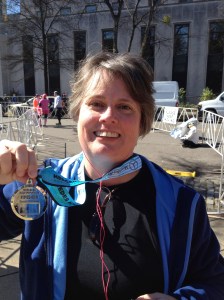
A Moment of Pure Happiness: Mercedes Half Marathon, 2013

On Saturday afternoon, I helped officiate at the funeral of a young man who was murdered. From where I sat, I saw the tears running down the faces of the pallbearers, young men, all of them. I saw the family’s devastation. As we recessed at the end of the funeral, I saw row upon row upon row of grief and sorrow. I was glad there were so many of us there for the family; I was so mindful that whatever we might have to offer in the way of comfort and consolation was but a drop of water in a desert of loss and desolation. No parent should have to bury their child, no one should have to die too young, too violently, too senselessly.

Perhaps as poignant as that afternoon have been the pictures that found their way to Facebook of a young man who was obviously droll and funny. Who shared a mop of gloriously red hair with his twin sister and baby sister. Who posted videos that allowed those of us who had not yet met him to get a sense of his musical gifts. Who stands goofing off with his father in one of the pictures where you can see the laughter and the joy and above all, the love they share.

This morning, a dear friend posted a picture of her parents’ wedding. The picture shows two young, gorgeous, radiant young people. My friend’s mom died too soon after that picture, in a horrible car accident that killed her and her toddler son, my friend’s baby brother. There would be far more loss and devastation ahead for my friend.

I find myself looking at my friend’s picture and the pictures of the young man we buried with new eyes. I am so aware of the happiness—in part, because I know the happiness was not as long-lasting as we all desperately hope for—for ourselves, and even more, for those we love. Perhaps it is another small reminder of my age, my vocation, the life I have lived, that I no longer take happiness for granted. I know too well how short-lived it can be. What I also know, though, is this: no matter how long or how short a time of happiness, the happiness is real. That moment that was captured, of A. and T. goofing around for the camera, that very traditional and singular wedding portrait my friend shared—that happiness was vividly, beautifully, purely real. You can’t capture it in a bottle, can’t stop time, can’t make it be more real than other parts of life. But neither can those moments be denied or diminished.

On Saturday afternoon, Andrew, the rector at Ascension preached a lovely homily riffing on what continues to be for me, the most powerful phrase of the Rite of Burial in the Book of Common Prayer: “All of us go down to the dust; yet even at the grave we make our song: Alleluia, alleluia, alleluia.” That was the phrase that got me through my mom’s death, that is the phrase I hold on to with all my might, still. And it is precisely, because we have known happiness that we are able to sing those Alleluias. For some this may seem a morbid, angst and gloom-filled assertion. For me, it is a fierce declaration and defense of the happiness that was, and is, and is to be.


In deep winter

DSCN1007

We are lent to each other for a very short time. These days, I am confronted with that truth to an extent that sometimes feels overwhelming. If you include the pauper funerals we’ve done since I was hired in September of last year, my boss and I have taken turns officiating at 19 funerals. We have two more at the end of the week, one of them particularly difficult because of the age of the young man we will bury, the son of a member of our congregations who died in tragic circumstances.

The time of death is so raw, fraught and confusing, whether there’s a large family involved or no family at all, whether death has been long expected and comes as a relief, or crashes into a family and leaves it shattered.   Words, especially mine, just don’t add up to much though that does not let me off the hook for stumbling through prayers, meeting and extending my condolences to a daughter as she looks at her mother’s casket for the first time at a cemetery where the wind is whipping cold. With each funeral I am asked to officiate for, I am more moved and more grateful for the words, the rhythms, the way in which the Episcopal Church Rite of Burial can bear the burden of death and allow for dignity, celebration and sorrow, all at once.

I don’t have much time for reflection and insight. These days, I make a to-do list early in the morning and work it through the day. I am grateful for incredibly small things: those who know me well know how much I despise driving, especially maneuvering in reverse. I’ve mastered backing into our driveway so when morning comes, I am good to go with a minimum of fuss. Such a small thing that gives me a sense of accomplishment and also makes my life easier. I am also grateful for the brief moments of connection with all kinds of people who let me see a glimpse of who they are before we move on. I am grateful for the fireplace that welcomes me in from the cold and the feel of cool sheets when I crawl into bed at night, so tired that going to sleep is my prayer.

Twelfth Night

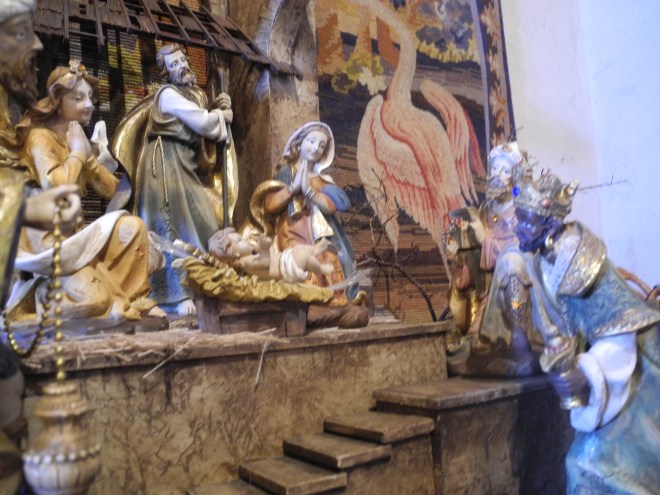
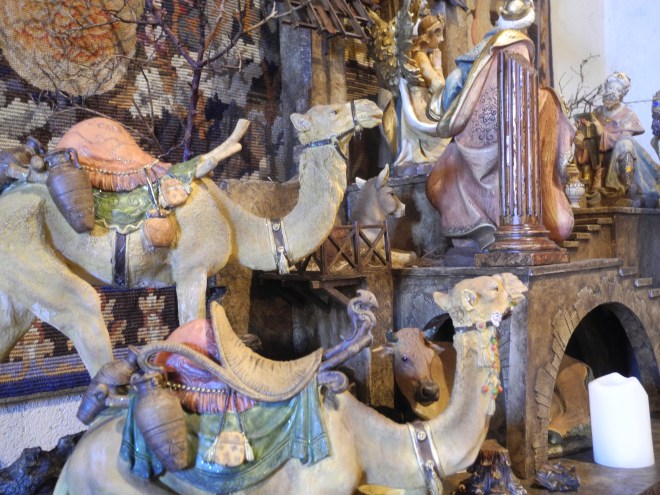
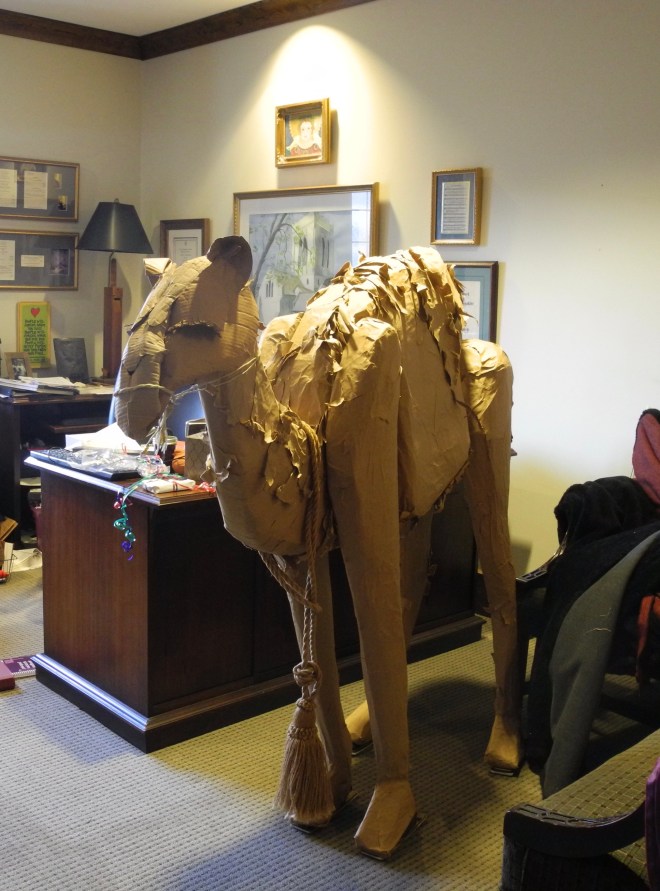
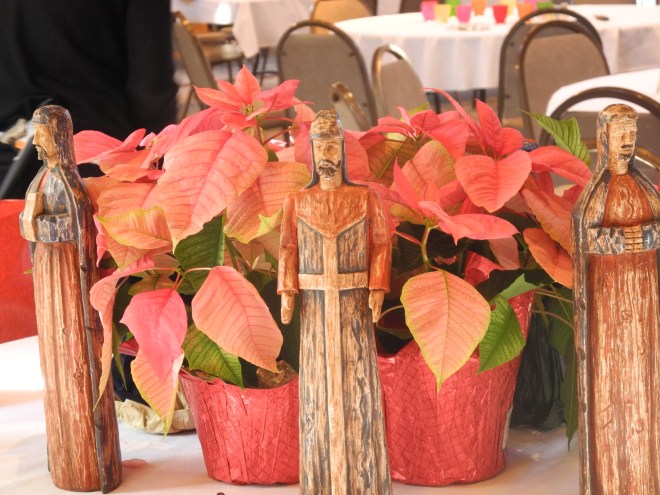
Ascension at Christmas is something to behold.  I love our angels all around the church; somehow, with the Christmas decorations up, they are especially dear.  I have also been taken by the nativity scene in the chapel, with its many animals, now that the three kings have arrived to see the child born of Mary.  Tonight we will have a Twelfth Night Celebration–a procession, camel and all–and do the traditional chalking of the doors around our campus before entering to have a feast. Twelve tables have been set up, each with a nativity set.  We will sing the Twelve Days of Christmas with each table required to act out one of the verses. I suspect by the end of the song, things will be quite rowdy and raucous.

I am thankful for all these different ways we remind, no, we refuse to allow ourselves to forget, that we are flesh and body and bone and so is the mystery of God’s love.  This business of faith is no easy abstraction nor is it even reducible to an act of the imagination. Everything about faith these days is about incarnation for me. My dad came up to visit us for Christmas and as we talked in those early days of his visit, it became clear that we needed to try to get him moved in with us.  Because of the legal maze that involves, my dad is not able to return to his home until the process to get a permanent resident/green card is complete, maybe as long as 6-8 months from now.

That means I watched my dad get so cold his teeth chattered yesterday–his 88 year old body is so not used to the winter weather. That means seeing grief, like I last saw the day my mom died, etched on his face, this time because bringing his dogs, his family, to join him is probably not possible. For me, it means waking up in the middle of the night, mind racing at the implications of such change, and making myself breathe slow and deep, so the tension can loosen its grip, so I can say my simple prayers out loud and let my own voice speak of God’s abiding, trustworthy ways.

It means that tonight, a clear cold night we will have of it in Lowndesboro, I have to remind myself to go out and look up. To have these eyes and this skin that feels the cold, and these ears that hear the rustling sounds of the country means to take in the night with all its magnificence.  All the beautiful colors of Christmas, the whimsical, playful, intriguing and beguiling smells, tastes and sounds of Christmas hush and fade.  And still, there is a star.DSCN2582

DSCN2578

DSCN2574

DSCN2594

DSCN2585

DSCN2583

DSCN2591

Word for 2016: Resilience

DSCN2186

We had an apocalyptic storm on Christmas Eve—for more than five hours, a fierce thunder and rainstorm raged around us and over 24 hours we had 5 inches of rain. There has been extensive flooding in the area and though the worst we got was water in our garage and Sherod’s shop, it is sobering to think that these are the kinds of storms that come with climate change. Even if I chalk this up to El Niño, I am convinced we’re moving into a new normal.

Services went on as scheduled, our sweet girl Maria had a place in the early Christmas Eve service, helping to ring bells with joy and gusto during the Sanctus. She did well on this longer visit and I miss her desperately, now that she is back in Ft. Lauderdale. We continue to gather the information to look at a move for my dad with some setbacks and some surprises, but overall, with a growing sense of clarity. All of this is woven into the regular patterns of work and worship at Ascension.

Somehow, it made for an absolutely wonderful Christmas even if one far less jolly and festive than in years past. I think probably, that’s the way it should be, given such heartache in the world.

In a while, cousins I haven’t seen for over a decade will arrive from North Carolina to spend New Years Eve with us. There’s a shrimp boil in the offing, Sherod will watch is Alabama game, at some point we will toast the New Year and then, some sleep. It feels like a life-time was crammed into a single year, when I consider where we were on January 1st of 2015. The word for 2016 is resilience—you take a few steps back to gain momentum and then jump again. So here goes…

The Hay Smells Sweet

DSCN3135

I am almost finished doing the Christmas pastoral care visits for our church. My dad got here last Thursday and Maria came in last night. My most serious foray into Christmas shopping happened night before last, on my way home, when I stopped at the Dollar store on one of the back roads I use sometimes. I needed to pick up a couple of decorations because it was time for Olaf the pesky elf to get Maria’s room ready for her visit.   What Christmas means keeps changing for me and I find myself moving further out to the edges of the celebration.

My dad is more fragile and his situation more precarious. We are making some hard, serious decisions, consulting with immigration lawyers and thanking our lucky stars that if our big rambling farm has anything, it has space.

I am pondering the truth that from the very beginning of our marriage, Sherod and I have found ourselves called to offer hospitality that is not about putting on a lovely gracious dinner with all the finery on display and a delicious meal waiting to be served, and then closing the door and breathing a sigh of relief that our guests have gone home. I retraced our steps in my mind this morning: 6 weeks after we married, we received Sherod’s 14-year-old daughter into our home. There were hard parenting lessons to learn with her. When she moved out after high school, I remember cleaning out her room in Memphis and unexpectedly finding a dress she had left. I slumped down the closet wall and wept. No matter how hard, it was good love.

A few years later, it was time to make room for Maria. We are still making room. There’s the wonder of Christmas through eyes that have not and will probably never stop seeing magic and silly elves who make mischief. There’s the need to match our pace to the effects of so many medications she’s on. We calibrate day to day, and in the first days after she arrives for a visit, hour by hour.

Now my dad. Who does not like hearing aids though he needs them so it feels loud in my house a lot. With him too, there will be much to learn. Unlike with my mom, whose decline I saw only in fits and starts, and then those last two intense weeks before her death, it looks like I, and Sherod, will walk alongside him for the rest of the way, whatever that way may be. I am both thankful and scared. We are up to 14 funerals at Ascension since September 1, and I had two funerals in the past 72 hours. Dying and death, filled with grace as they can be, nonetheless hurt.

I go back to my old standbys, including Eliot’s The Magi, and how in these middle years, where death ends and birth begins is almost indecipherable. I love a good party and some of the parties that we have had in our home through the years have been epic. There was one involving the moon and the Jungle Queen that can still make me grin. But the hospitality I have learned as an adult asks me to open room in the inn for a tired person, or two, or three, who need care, do not bring distraction and don’t want to be impressed but simply loved.

And so out in our farm, we start anew making room for one more. I thank God for knowing now, that hay does smell sweet. That the animals will provide comfort and warmth, especially to an old man whose hands are always cold now. I am grateful for fresh eggs and a husband who reaches out early on a winter morning and holds my hand in the dark as we prepare to tend to our guests.

Candles

I did not go to church today. Instead, I keep slowly—frustratingly slowly—finishing the editing part of the translation project. And I have been taking breaks to start putting up some of the Christmas decorations. It has struck me today that an enormous part of the decorations for Christmas in Sweden is about putting out candles. When I was growing up, my mom had a small, antique trunk where she stored candles—especially red ones, and small Swedish ones called Prima Julgränsljus. My brothers and I risked death if we dared to open her candle trunk and even as an adult, I stayed out of it.

Last year, I went to Panama to help my dad prepare to move into a much smaller house than the one he had lived in with my mom. During a long week of sorting and finding new homes for stuff, my dad and I shook our heads at my mom’s habit of stocking up–seriously stocking up–on things like candles. But when I went through her candle trunk, all I found were a few half-used Julgränsljus—another small and pointed reminder that my mom is dead; she would never have let herself run out of such an important part of Christmas.

This morning, I went to my candle drawer almost as soon as I got started with the decorating. It was only this morning that I realized how I had followed right behind my mama in having my own stash. In the front of the drawer were two boxes of the Julgränsljus. When I was in Sweden a couple of years ago, I bought several boxes and just opening and smelling them evokes a thousand thousand memories.

Today is Lucia Afton—the traditional Swedish celebration of Sweden’s patron saint and the promise that after long, long nights of bitter cold and darkness, light will come again. It is lovely that decorating for Christmas means I will put out all kinds of candles all around the house. I was also reminded of my absolute favorite piece of Christmas music. With a healthy dose of nostalgia, of genuine grief and sorrow, of thankfulness and anticipation as I prepare for my father and my daughter to come for Christmas, I listened to Nu tändas tusen juleljus. A simpler version of church…

Too Much

DSCN3136 (1)

A New Dawn At La Finquita On 5 Dec 2015

This evening, I was sorely tempted to jump into a push and pull of outrage related to a picture circulating on Facebook. Because of the comments associated with the picture, I reported it to FB as fostering hate and intolerance. After that, I turned my attention to other pressing work I am trying to wrap up. The fear, anger, sadness, in some ways, the despair, continued to churn in me long enough to call me to attention.

The echo chambers of social media like Facebook are especially insidious, I think, in times of great spiritual challenge, like our country is facing. They amplify our worst fears and at least for me, push on buttons that have very little to do with my nobler angels. I am declaring a Facebook moratorium for myself until after Christmas. I will continue, as time permits, to blog at www.revrosa.org and welcome comments and conversations there, or directly with me via phone or email. The joy of Facebook is the connections with people who I rarely see and who I love. To all of you, may this be a season of new hope and rediscovered laughter and joy. Keep peace alive…

Belonging

Today I was invited to lead a devotional with the staff at the Agriculture Department for the State of Alabama. A group of about 20 people gathered and we talked about Joseph, and how things often don’t turn out like we wanted them to. We talked about improbabilities and what can grow in a place easy to dismiss, like Alabama. I found the conversation deeply moving. I was in a roomful of folks who, mostly, are of a very different theological/denominational starting point than mine, that still does not ordain women. Our political and social views are probably miles apart too. I was a guest and I was standing on the edges of their world. It is equally true, though, that we also have our being on the very same ground.

Almost all of them are active in farming in their private life away from the Ag Dep’t so we share knowledge about the color, and texture and smell, and richness of the earth, the red dirt we work. People, including me, so easily dismiss government workers as bureaucrats. Taking their work seriously—simply getting to spend time with people who work in a big, somewhat dreary and profoundly functional building—turned out to be a grace-filled way to start my day, even as I have and continue to prickle and push against the blurring of lines between state and religion.

My work has changed quite radically from anything I did before. These days, there’s some disjointedness: I pick up pieces where necessary, tie up loose ends, pinch hit. I am not responsible for providing high-level, ‘strategic leadership’ (though I am grateful for the times I am invited to provide advice and counsel), try to stay flexible to respond to the unexpected. My work doesn’t have the kind of glamour of travel or the prominence that comes with projects at the national/church-wide level like I was involved in last year. I know now that truly, I am a journeyman (person) of the church.

I looked up the etymology for assist and help—which is what the bulk of my work is about now. To assist comes from words that mean to stand by, to attend, to stretch towards. Help derives from words meaning to succor, benefit, cure, amend. I love that much of what I do is stand by or walk with others. To stretch towards others is not something that comes easily for me. My best friend and I had a conversation recently that helped me understand that for much of my life, I worked hard to define my identity—who I was—and I did a lot of that by defining who I was not. There’s such a tiny space between clarifying boundaries and slipping into outrage about the Other—whoever the Other might be.   I know a lot more about who I am now and that allows me to hear others and be with others in ways I couldn’t before

I believe the carnage in endless replay of these days is shaped, at least in part, by gun laws that do not do enough to protect the innocent. I take that position in a state where gun rights are an enormously big deal and we have discussions about open carry policies for our churches. I live in a state Donald Trump has visited regularly and I know and love people who are swayed by at least some of his arguments. It is easy to be outraged (and I am) by the hateful rhetoric Trump uses, by the hideous violence that comes when companies profit so much from selling death through guns. It is easy to speak words from the place outrage. There is work of justice to do and a place to question insistently who, in the end, truly profits from so many guns and assault weapons.

My work ,though, is both related and different. I’m a priest and during this time of the year, I end up preaching quite a bit and am asked to do a fair amount of ‘splainin’ about the mystery we call the Incarnation. I don’t for a minute believe I understand that mystery enough to talk about it much. What I do have is a new heart for learning more about hard love across so many tears and fractures in our country, and how to stretch towards the community I am a part of that sees the world and the challenges of our time in ways so fundamentally different from mine.

I believe this is where I am called to live right now because you see, it isn’t enough to know who I am, or even Whose I am. “Those people” and I? We are brothers and sisters. The future of our children depends on finding a way forward other than the endless fractures and divisions we have surrendered to. We are brothers and sisters and we are each other’s keepers.